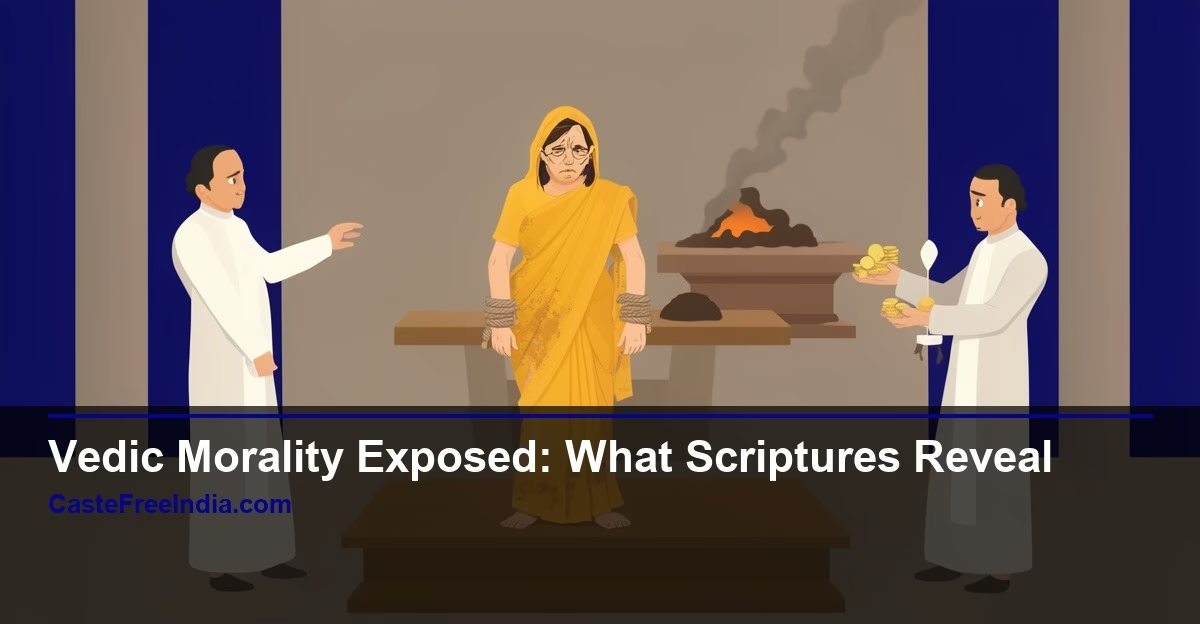
Vedic Morality Exposed: What Scriptures Reveal
Brahminical literature exposes Vedic morality as a self-portrait of kings, rishis, and Brahmins – painted in their own scriptures. This analysis does not concern the Aryan Invasion or Migration theories. Instead, it examines what Brahminism recorded about itself, its ancestors, and its practices. Evidence drawn directly from these texts reveals a civilization starkly different from the glorified image often presented.
This post dissects scriptures from the Vedas to the Puranas, exposing a history of wife-selling, ritualized promiscuity, and animalistic sexual practices that were institutionalized norms. The discussion draws on Dr. B.R. Ambedkar’s seminal work, Riddles in Hinduism, which compiled these references meticulously, challenging the sanitized narratives of Hindu civilization.
The Fabrication of Yugas: Distorting Time to Erase History
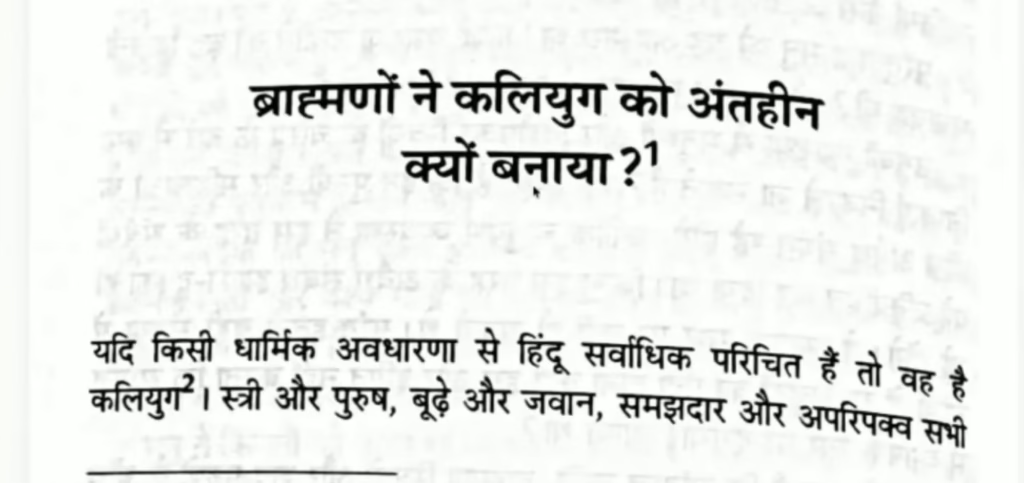
The concept of Yugas — Satyug, Tretayug, Dwapar, and Kaliyug — originally functioned as a numerical system in dice games, not a cosmic timeline. Brahminical texts later transformed this into an elaborate chronology, extending Kaliyug from 1,000 years to an endless cycle by adding lakhs of years through divine multipliers. Evidence from the Mahabharata shows that Kaliyug was supposed to end with the arrival of barbarians, Shakas, Kushans, and Palas. Astrologers themselves admitted that Kaliyug ended around 165 BCE. The manipulation of time obscured historical realities, particularly the rise of Buddhism and foreign invasions, by pushing events into an unresolved, eternal Kaliyug.
This distortion is exposed in Ambedkar’s Riddles in Hinduism, in the chapter “Why Did the Brahmins Make the Kaliyug Endless?” It cites the Mahabharata’s Vana Parva (189–190) as predicting that at the end of Kaliyug, Yavanas, Shakas, and Barbaras would overrun India. Yet, when these invasions occurred, instead of acknowledging the end of Kaliyug, Brahminical astrologers extended it indefinitely, burying evidence of their failed prophecies.[source]
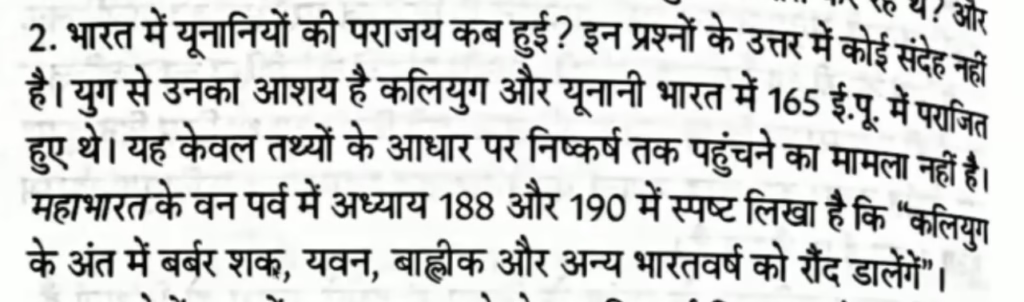
The Dice-Game Origins of Yuga Terminology
The terms Krita, Treta, Dvapara, and Kali originally referred to throws of dice — winning numbers in a game — and their transformation into vast epochs was a later interpolation, designed to create a mythical past that never existed.
Scriptural Contradictions on Yuga Duration
Manusmriti (1.68–71) divides the Yuga cycle into 4,000, 3,000, 2,000, and 1,000 divine years, with sandhya periods. Yet early texts like the Mahabharata mention contradictory figures, exposing the fabricated nature of these timelines.
The Political Motive Behind Extending Kaliyug
By making Kaliyug endless, Brahmins could claim that all contemporary social degeneration was part of an inevitable cycle, absolving their caste system of any blame while dismissing Buddhist and other critiques as symptoms of the age.
Narmedh Yajna: Human Sacrifice as a Religious Practice
The Vedas sanctioned human sacrifice, known as Narmedh Yajna or Purushamedha. This was not a metaphor but a literal ritual where practitioners offered human beings to the gods. Ambedkar notes that the British colonial government banned this practice in 1854, just three years before the 1857 rebellion. The fact that a foreign power had to outlaw such a ritual through legislation — Act XXVII of 1854 — underscores its prevalence and the moral bankruptcy of the society that practiced it.
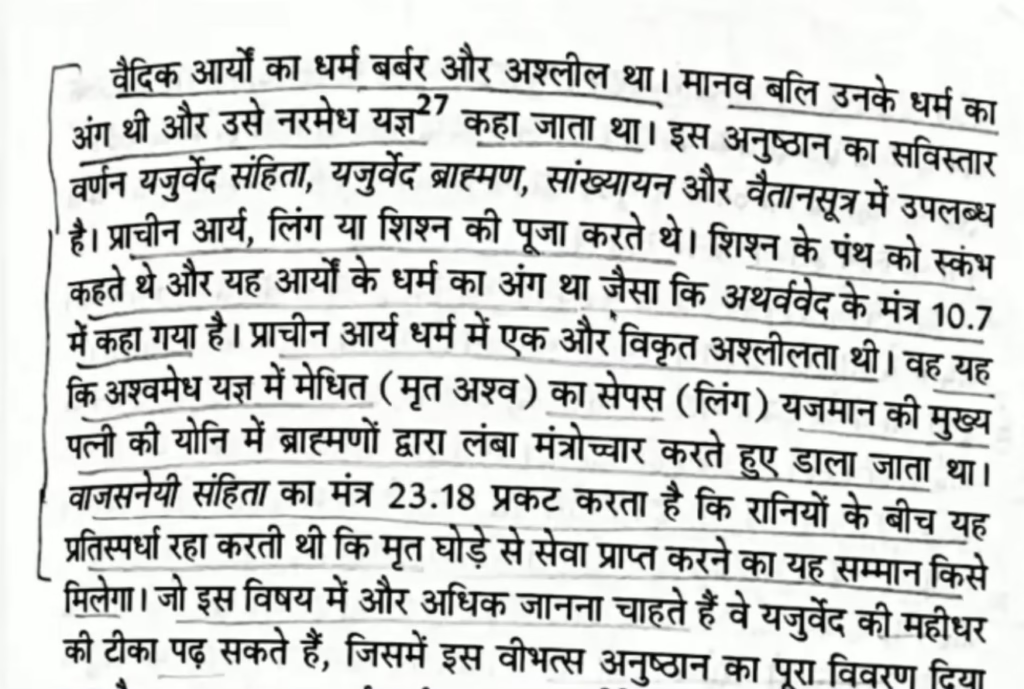
The Vedic Aryan religion was barbarous and obscene. Human sacrifice was a part of their religion and was called Narmedh Yajna.
The British Ban of 1854
The British Act XXVII of 1854 specifically targeted human sacrifices, forbidding them under penalty of law. This intervention highlights the extreme cruelty of Brahminical rituals that persisted into the modern era.
Scriptural Sanctions for Human Offering
The Shatapatha Brahmana (13.6.2) and Aitareya Brahmana (7.15) describe the Purushamedha, listing the victims to be tied to sacrificial stakes. The Yajur Veda (Vajasaneyi Samhita 30–31) also mentions the offering of various human types, indicating a systematized practice.[source]
Ambedkar’s Critique of the ‘Hindu Science’ Myth
Ambedkar pointed to this ritual as proof that the claim of ‘Vedic science’ is hollow. If a religion requires state intervention to stop murder in the name of worship, it forfeits any moral authority.
Lingam and Shishna Worship: The Phallic Cult of the Aryans
Ancient Aryans worshipped the lingam and shishna (penis). The Rigveda (7.21.5, 10.99.3) mentions the Shishnadevas, those who worship the phallus. The term Skambha (support, pillar) in the Atharva Veda (10.7) is also interpreted as a phallic symbol. This was not just a fringe cult but an integral part of the religion, later sanitized into Shaivism’s Shiva lingam. However, the original Vedic references leave no doubt about the explicit sexual nature of the worship.
The Aryans worshipped the linga or shishna. This cult was called Skambha and was a part of Aryan religion.
Shishna in the Rigveda
Rigveda 7.21.5 and 10.99.3 condemn the Shishnadevas, indicating that non-Vedic tribes practiced phallic worship, yet the very mention and later assimilation show its deep roots in Aryan society.
Skambha as Phallic Symbolism
Atharva Veda 10.7 is entirely dedicated to the Skambha, describing it as the cosmic pillar. Scholars like Swami Vivekananda and modern Indologists have noted its phallic connotations.
The Sanitization into Shiva Lingam
Later Puranic literature reinterpreted the lingam as a metaphysical symbol of Shiva, erasing the overtly sexual origins. This whitewashing continues today, with defenders claiming ‘lingam’ merely means ‘sign’. Read more: Lingam Origins: Myth vs. Evidence of True Origins
Ashvamedha Yajna: Ritualized Necrophilia and Public Obscenity
The Ashvamedha or Horse Sacrifice involved the chief queen (Mahishi) copulating with the sacrificed horse’s penis (medhra) while priests recited mantras. Yajur Veda (Taittiriya Samhita 7.4.19) explicitly describes this act. The ritual was a competition among queens for the ‘honour’ of receiving the horse’s organ, and the king often made the choice himself. Ambedkar calls this the most obscene practice of the Aryan religion, revealing a complete collapse of sexual ethics.[source] Read more: Ashwamedha Yajna: Unpacking Controversial Descriptions
In the Ashvamedha, the Medhra (penis) of the dead horse was inserted into the Yoni (vagina) of the Yajman’s chief wife, while Brahmins chanted mantras.
The Scriptural Basis in Yajur Veda
Yajur Veda Taittiriya Samhita 7.4.19 states: “The Mahishi lies down near the horse… the priests cover her and the horse… and the Adhvaryu raises the horse’s penis and inserts it into the queen’s vulva.” This is not metaphorical but a detailed liturgical instruction.
The Queens’ Competition for the ‘Honour’
Ambedkar notes that the queens vied for this privilege, treating it as a mark of favour. The Mahabharata (Ashvamedha Parva) also alludes to the ritual, with Yudhishthira performing it under the guidance of Vyasa.
British Legal Reforms and the Ban
While the Ashvamedha was largely symbolic by the 19th century, the underlying attitudes persisted in other forms. The British criminalized many such practices through the Indian Penal Code (1860), targeting obscene rituals.
The Culture of Liquor and Meat: Intoxication as Religious Duty
Vedic Aryans were not teetotalers or vegetarians. They consumed Soma and Sura (liquor) ritually. The Yajur Veda invokes gods to strengthen Brahmin and Kshatriya with liquor. Manu Smriti (11.96–97) prescribes penances for drinking, but these came later as Brahminism reformed under Buddhist influence. The Ramayana and Mahabharata show their heroes indulging in alcohol and meat. Rama and Sita drank Madhu (wine), and Krishna and Arjuna consumed intoxicating drinks while seated on golden thrones.
The Yajur Veda says: O God Soma, being strengthened by Sura, pleasing the gods with your pure spirit, give strength to the sacrificers, the Amrit-drinking Brahmins and Kshatriyas.
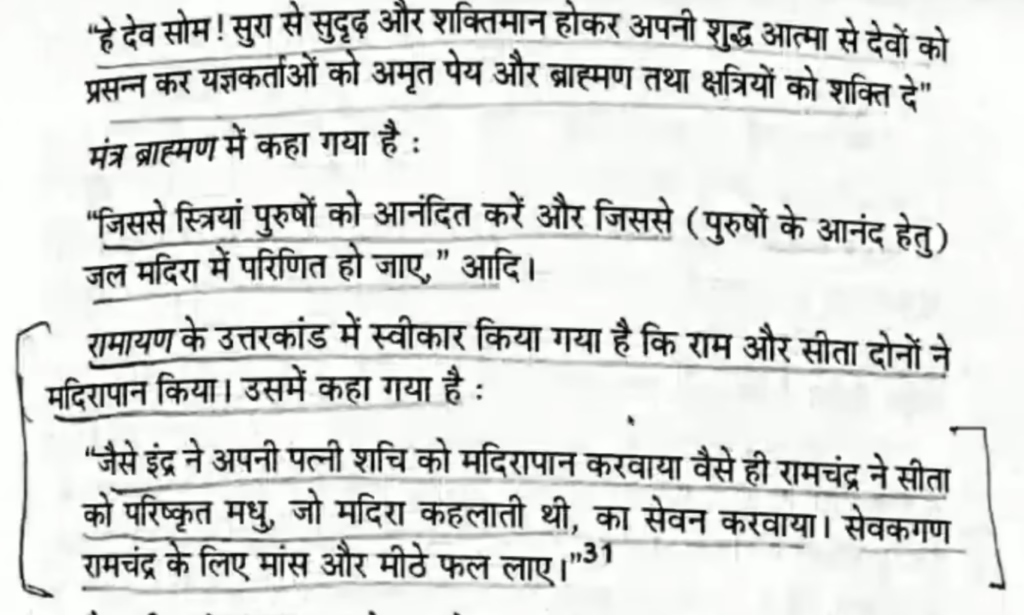
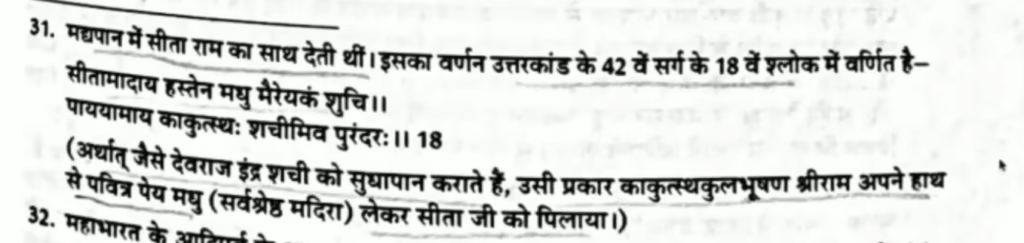
Rama and Sita’s Drinking in Ramayana
The Uttarakanda (42.18) of Valmiki’s Ramayana describes Rama serving Sita purified Madhu, much as Indra served Sachi. The verse explicitly mentions wine and meat being served to guests.[source]
Krishna and Arjuna’s Feast in Mahabharata
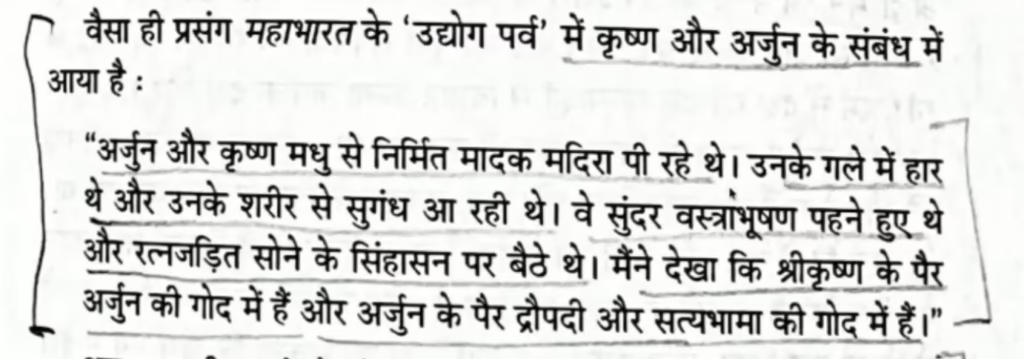
Udyoga Parva (58.22–23) details Krishna and Arjuna drinking wine, wearing garlands, with Draupadi and Satyabhama massaging their feet. This scene destroys the later Vaishnava projection of a celibate, teetotal Krishna.
The Shift Under Buddhist Influence
Post-Buddha, Brahminical texts began condemning alcohol and meat to differentiate from Buddhist asceticism, leading to the vegetarian, prohibitionist stance of modern Hinduism.
Marriage or Mating? The Absence of Wedding Norms in Vedic Society
Vedic society lacked a fixed marriage system. Unregulated sexual relations and incestuous unions were common. Fathers married daughters, sons shared mothers as wives, and brother-sister marriages were institutionalized. Ambedkar cites numerous examples: Brahma married his daughter Shatrupa, who then became the wife of their son Manu. Daksha married his sister, and his daughters were later married to him, his father, and his son. The Harivamsa Purana (Chapter 2) describes Soma, who had ten fathers, cohabiting with his daughter Marisha, who was also the wife of all ten fathers.
Brahma married his daughter Shatrupa. Their son Manu also married Shatrupa (his mother). Manu was the son of Brahma and Shatrupa, and also the husband of Shatrupa.
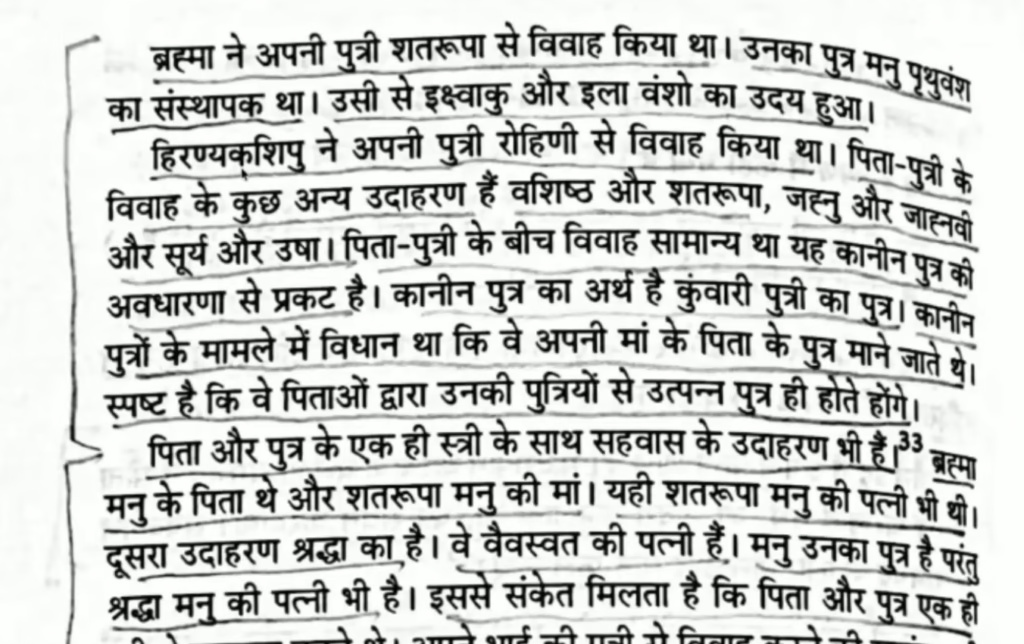
Father-Daughter Unions in the Puranas
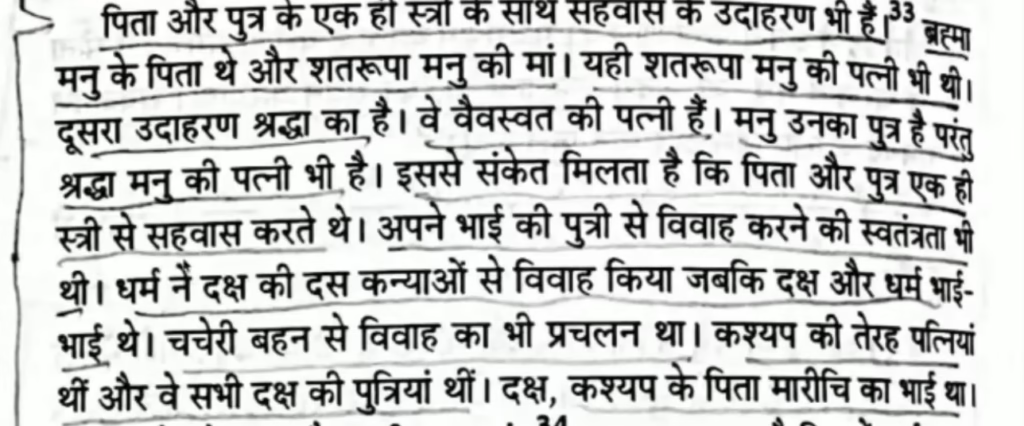
Vashishtha and Shatrupa, Jahnu and Jahnavi, Surya and Usha — all were father-daughter marriages. The concept of the Kanina son (son of an unmarried daughter) further confirms that daughters bore children to their own fathers, as the child was legally considered the father’s son.
Brother-Sister Marriages as Norm
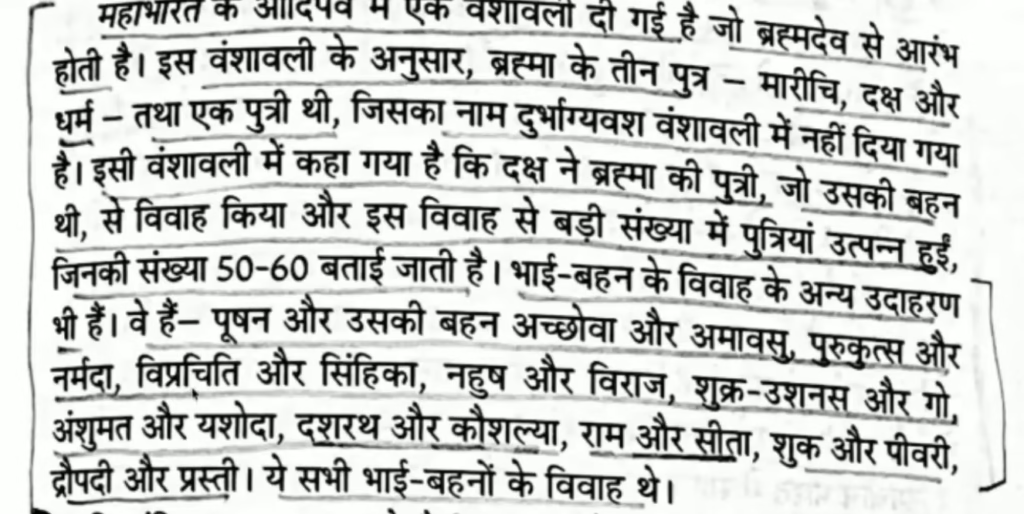
Daksha married his sister, Yama and Yami attempted intercourse, and Dharm married ten daughters of Daksha (his cousins). Dasharatha and Kausalya were also said to be brother and sister, making Rama and Sita sibling-spouses.
Mother-Son Cohabitation Without Stigma
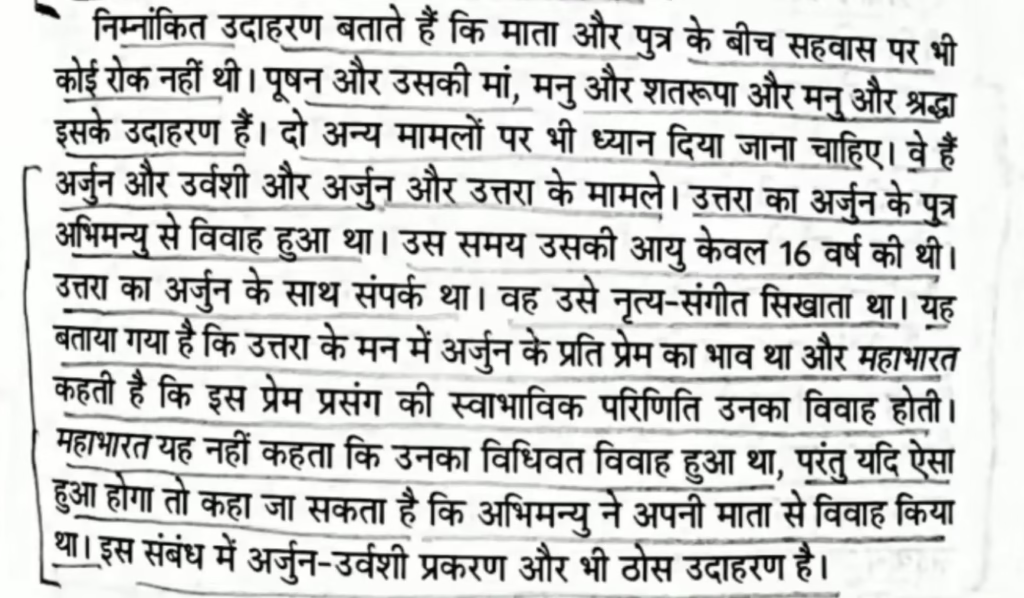
Pushan and his mother, Manu and Shatrupa (as detailed), and Shraddha and Manu are examples of mother-son sexual relationships. Society accepted this as part of the moral fabric, not punishing it.
The Practice of Selling Wives and Daughters for Cattle
People openly sold wives and daughters. The Arsha form of marriage involved the groom’s father giving a gomithuna (cow and bull) to the bride’s father. Thus, a woman’s price was one cow and one bull. Ambedkar highlights Harivamsa Purana (Chapter 79) which records that Brahmins sold their wives to priests as dakshina (ritual fee). Wives were also rented out for sexual purposes, as seen in the story of Madhavi, whom Galava passed from king to king to obtain horses for his guru.
Not only fathers sold their daughters, but husbands also sold their wives. Brahmins sold their wives to the priest as part of the ritual fee.
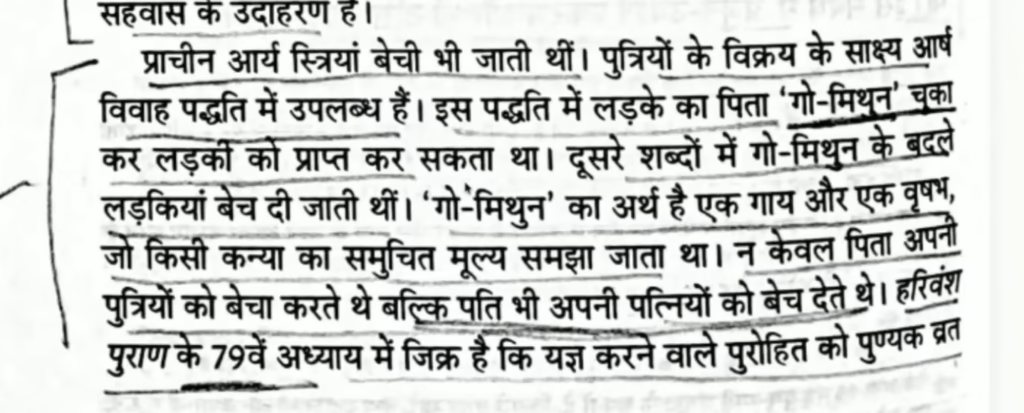
Gomithuna as Bride Price
Manu Smriti (3.29–34) classifies the Arsha marriage as one where a bull and a cow are given to the bride’s family, explicitly linking marriage to a commercial transaction.[source]
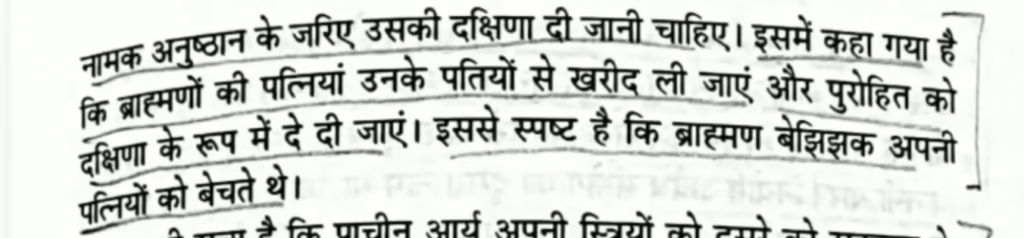
The Madhavi Episode in Mahabharata
Madhavi, daughter of Yayati, was lent to three kings and then to Vishwamitra, each time bearing a son. After fulfilling the contract, her father returned her and then married her off to another. This narrative normalizes sexual slavery.
Brahmins as Sellers and Buyers
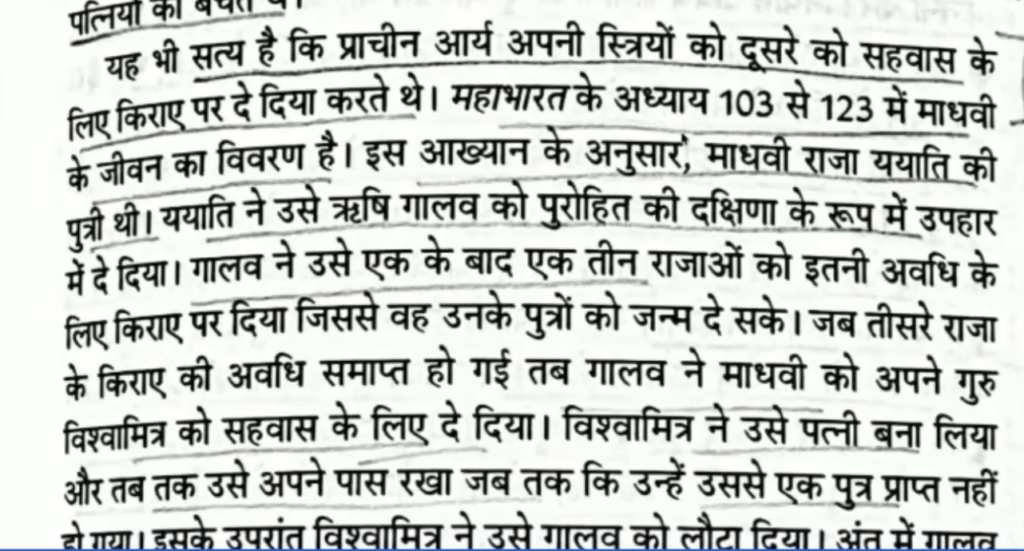
The Harivamsa (79.14–15) prescribes that for the Punyak Vrata, Brahmins’ wives should be purchased and given to the officiating priest, institutionalizing the commodification of women.
Niyoga: Systematized Adultery with Religious Sanction
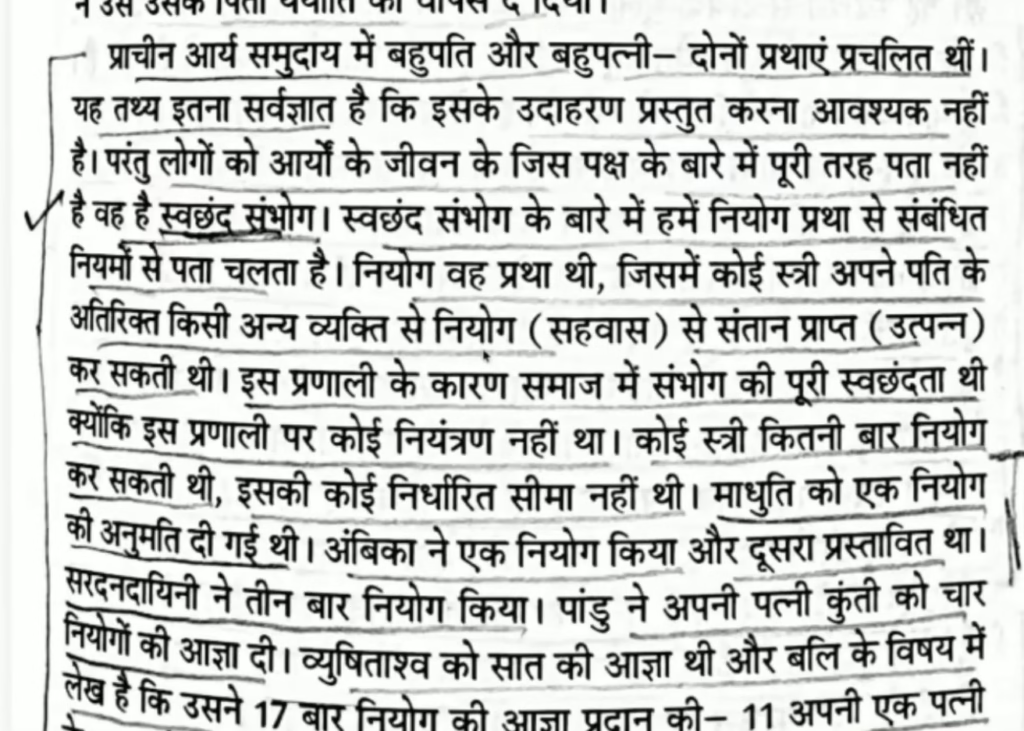
Niyoga allowed a woman to have sex with a man other than her husband to produce offspring. No limit existed on the number of Niyogas — a woman could have seven, eleven, or even seventeen. Men would command their wives to undergo Niyoga, sometimes while still capable themselves. This was not a desperate measure but a well-regulated form of adultery. Pandu commanded Kunti to have four Niyogas (she had one earlier, unknown to Pandu); Madri had one but with twin gods, resulting in two sons. Bali had his wives undergo 11 and 6 Niyogas respectively. The practice was so common that Draupadi, with her five husbands, was praised in comparison to Jatila Gautami, who had seven rishi husbands.
Niyoga is the sanctioned practice where a woman could have sexual intercourse with any man other than her husband to obtain a child. There was no restriction on the number of Niyogas.
The Rules (or Lack Thereof) in Niyoga
Manu (9.59–63) and other Dharmashastras allow Niyoga when the husband is impotent, dead, or otherwise incapable. However, the restriction to husband’s brother (devara) was often violated, and the number of times was not capped.
Examples From Itihasa-Purana
The Mahabharata provides numerous cases: Kunti’s sons from gods, Madri’s from Ashwinis, Amba’s Niyoga with Vyasa, and the wives of Vichitravirya. These are celebrated, not condemned. Read more: Mahabharata: History, Lineages, and the Truth of ‘Niyoga’
The Link to Polyandry and Free Sex
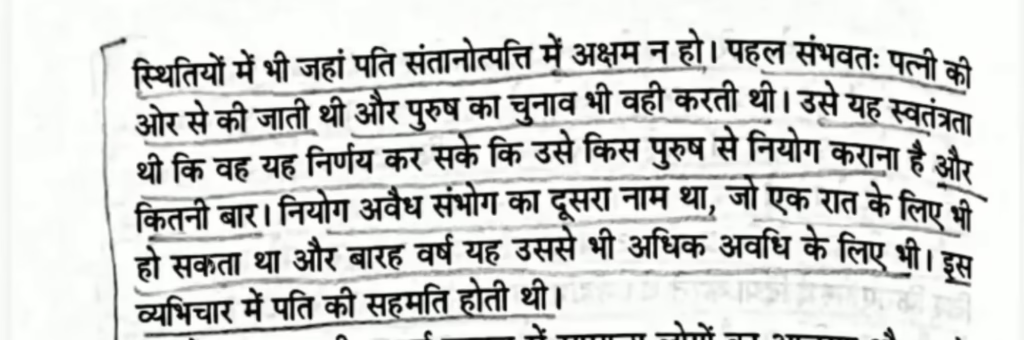
Niyoga led to a society where polyandry (Draupadi’s marriage) was accepted and women had sexual autonomy, but only as vessels for male lineage continuation, reducing them to breeding stock.
Rishis as Beasts: Bestiality and Public Copulation in Brahminical Lore
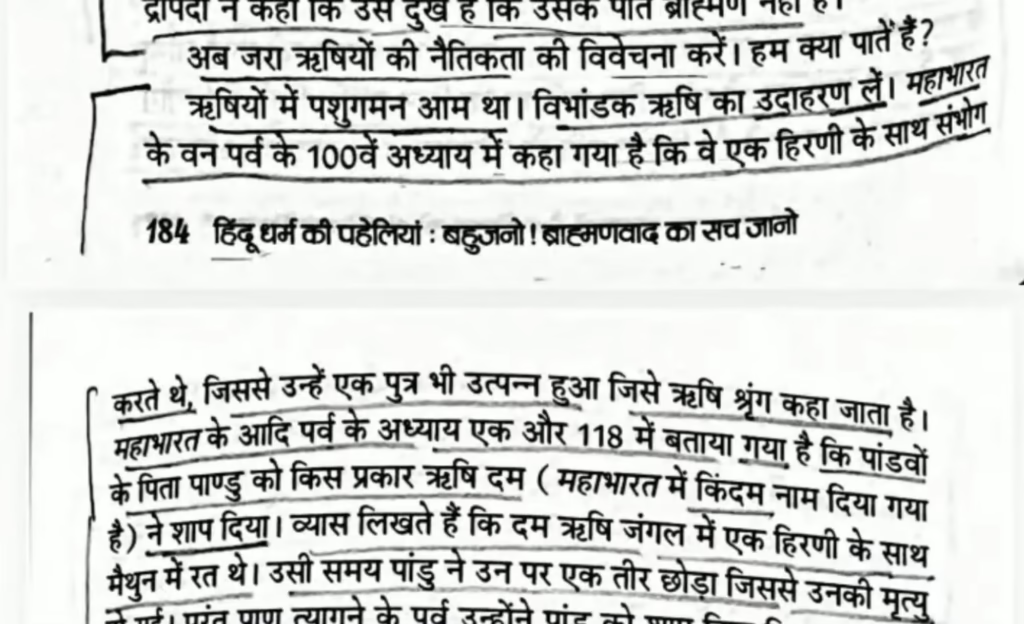
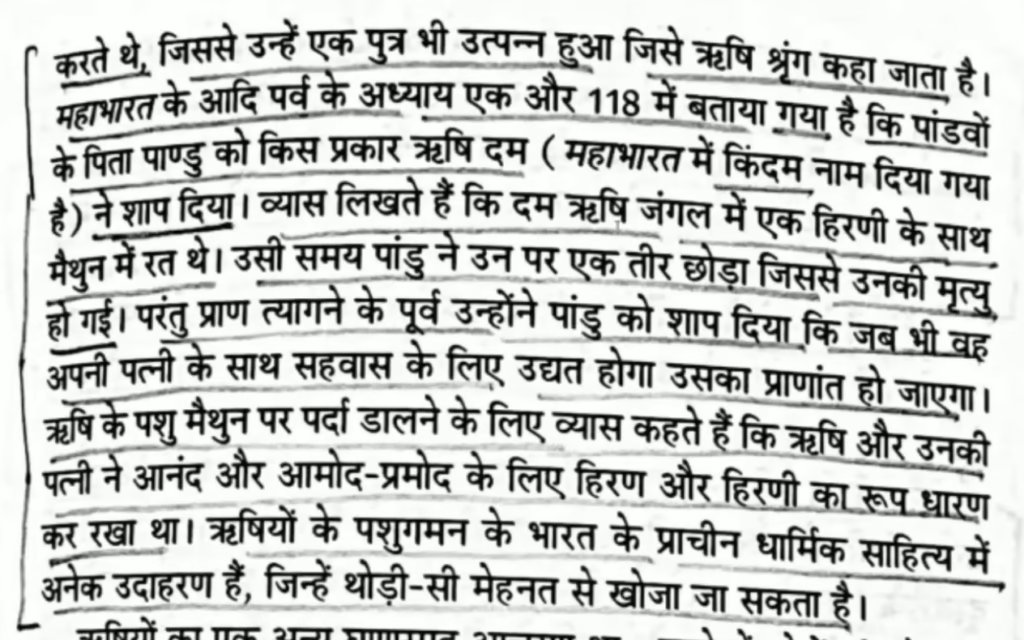
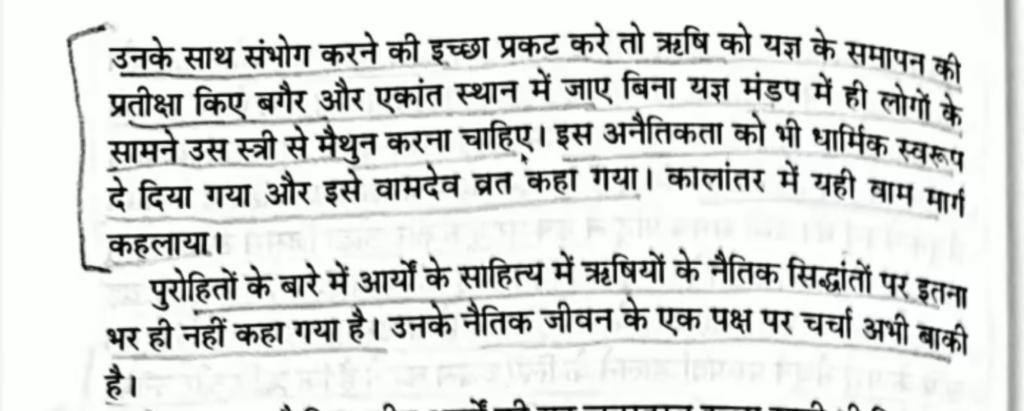
The moral character of rishis was depraved. Bestiality was common: Rishi Vibhandaka copulated with a deer, begetting Rishi Shringi. Rishi Kindam took the form of a deer with his wife for pleasure, leading to his accidental killing by Pandu. Open-air sexual intercourse in full public view was also a rishi practice. Rishi Parashara copulated with Satyavati (Matsyagandha) in a boat in plain sight. Rishi Dirghatamas did the same publicly. The Chhandogya Upanishad prescribes the Vamadeva Vrata, stating that if a woman approaches a rishi during a sacrifice desiring intercourse, he must oblige her immediately, without seeking privacy, even in the sacrificial enclosure, because this is a sacred duty.
If during a sacrifice a woman expresses a desire for intercourse, the rishi must have sex with her then and there, without waiting for the sacrifice to end or seeking a private place. This is called the Vamadeva Vrata.
Scriptural Endorsement of Bestiality
Mahabharata Vana Parva (Ch. 100) and Adi Parva (Ch. 118) narrate Vibhandaka and Kindam’s deer-copulation. These are presented as part of the rishi’s forest life, not as aberrations.
The Vamadeva Vrata in Chhandogya Upanishad
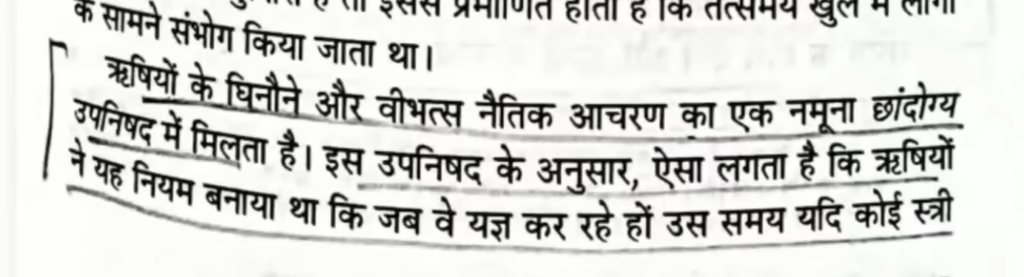
Chhandogya 2.13.1–2 instructs that a rishi should not refuse a woman’s sexual advances during a ritual. This institutionalizes sexual hospitality as a religious act.
Rishis as ‘Stud Bulls’ for Royal Offspring
Kings sent their queens to rishis for impregnation — a form of eugenic breeding. This turned rishis into a professional class of breeders, with some operating as full-time procreators for hire.
The Gods’ Right to Aryan Women: The Origin of the Wedding Ritual
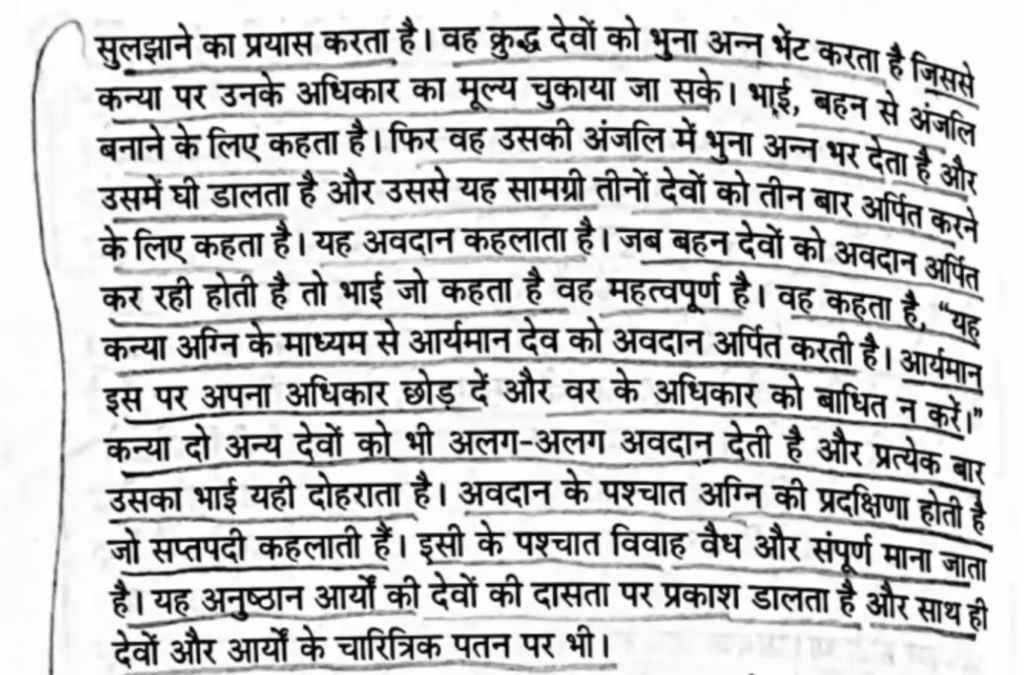
The Rigveda (10.85.40) establishes that an Aryan woman belongs first to Soma, then to Gandharva, then to Agni, and only after that to her human husband. The marriage ceremony described in the Ashvalayana Grhyasutra (1.7) is designed to free the bride from these divine claims. The ritual of Saptapadi (seven steps) after offering fried grain (Avadana) to Aryaman, Varuna, and Pushan is a transaction where the brother pays off the gods with food, pleading them to release their rights over the bride. The husband treats these gods as enemies, forcibly taking the bride and making her tread on a stone to make her firm against them. This reveals that marriage was originally a battle against divine gang-rape, institutionalized through priesthood.
First Soma, then Gandharva, then Agni — these gods have the first right over the Aryan woman. Only after them does the husband have any right. The wedding ritual exists to buy off these gods and free the woman from their bodily control.
The Rigvedic Hymn 10.85.40
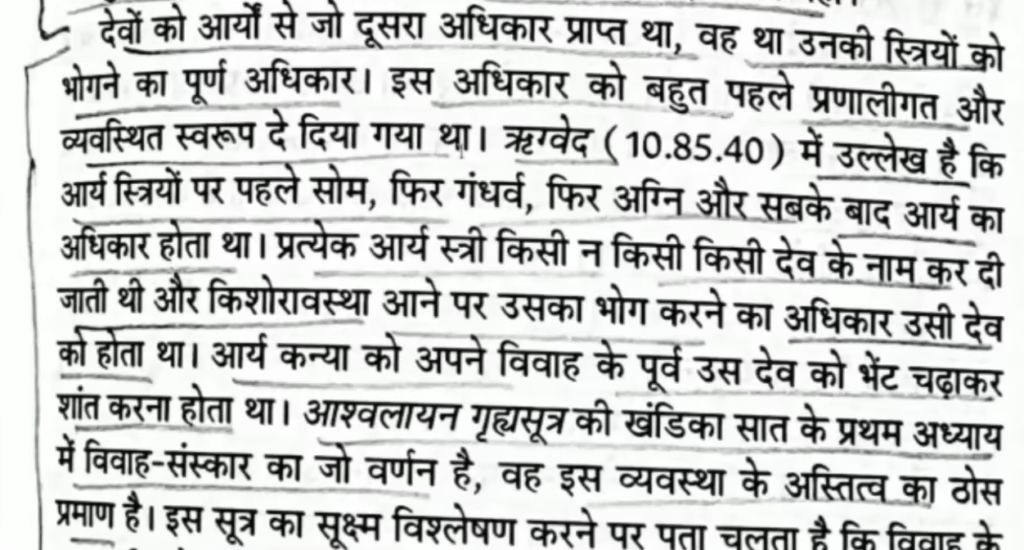
The verse explicitly states: “Soma first possessed thee, Gandharva second, Agni third; thy fourth husband am I, a human.” This is the cornerstone of Hindu marriage theology.
The Ashvalayana Grhyasutra Ritual
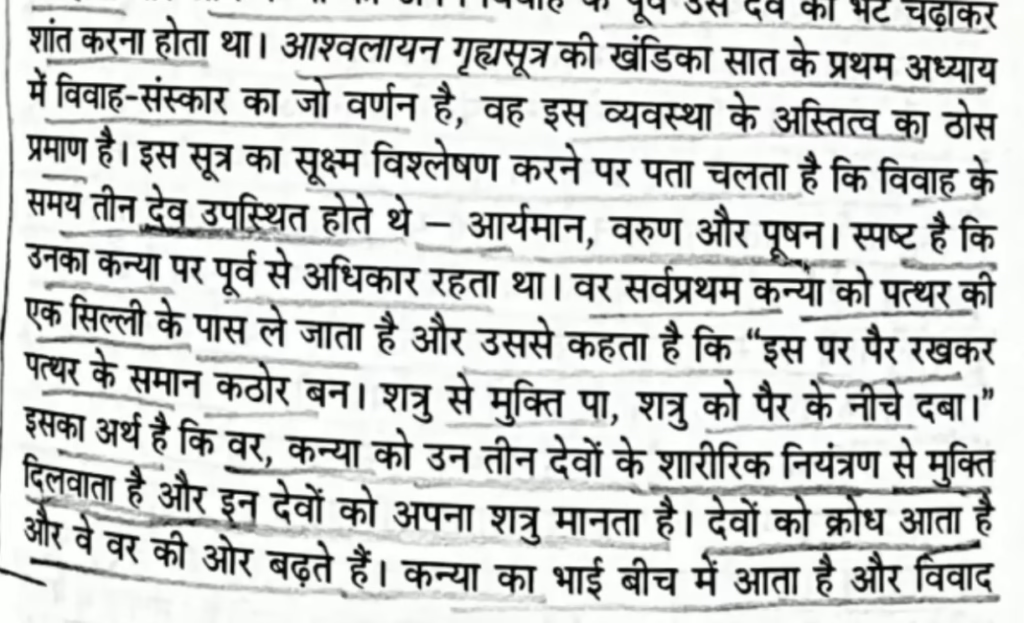
The brother offers oblations to each god, saying: “This girl is offering an oblation to Aryaman; let Aryaman release his hold on her and not hinder her husband’s rights.” The stone-treading symbolizes crushing the gods’ claim.
Modern Implication: Every Hindu Marriage Reenacts This
Even today, the Saptapadi and the brother’s role are central. Lawyers know that Saptapadi is the essential legal component of Hindu marriage (Section 7, Hindu Marriage Act, 1955), making this ancient divine sexual right the binding force of the sacrament.
Brahmins and Devas: Pimps and Patrons of a Sexual Feudal System
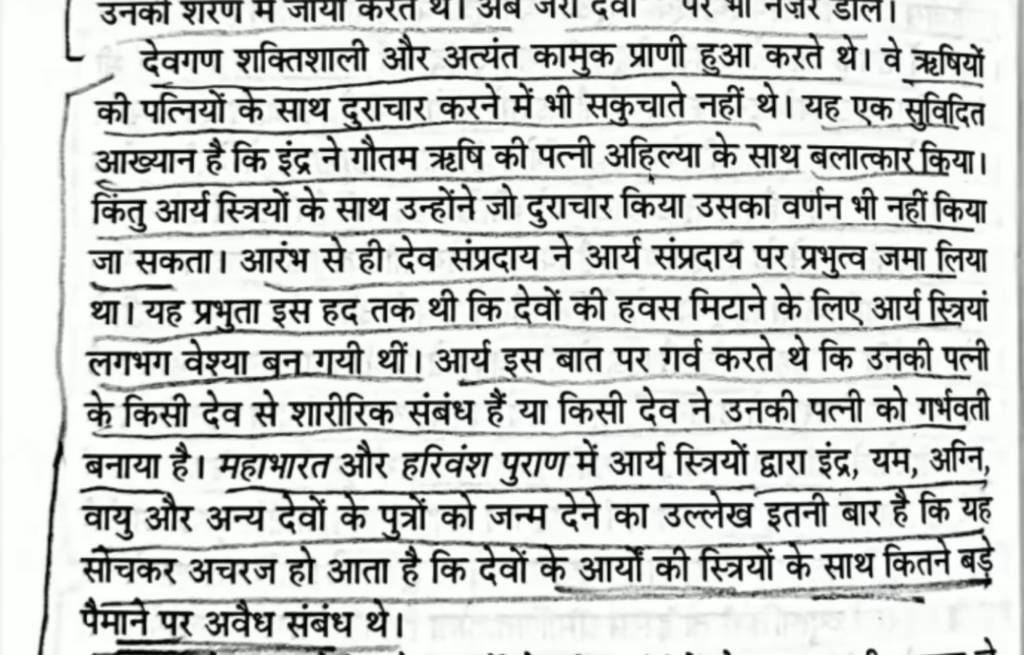
The devas (gods) were lustful beings who routinely raped rishis’ wives — Indra with Ahalya being the prime example. Yet Aryans took pride in their wives bearing children from gods, considering it a mark of honour. The gods had a feudal right over Aryan women: in exchange for protection from rakshasas, Aryans paid tributes of yajnas (food) and women. This system was so entrenched that Aryan women were effectively dedicated to gods, and the priests (Brahmins) acted as middlemen, ensuring the gods’ ‘dues’ were collected. The Brahmins’ own wives were not exempt; they were sold and rented.
The Devas were powerful and extremely lustful. They did not scruple to commit adultery with rishis’ wives. Aryans were proud that their wives had physical relations with the gods or that a god had made their wife pregnant.
Indra’s Assaults as Divine Right
Indra’s rape of Ahalya (Ramayana Bala Kanda 47–48) is a celebrated story, but the underlying system was that gods could claim any Aryan woman. This mirrored the feudal droit du seigneur.
Economic Basis: Yajna for Protection, Women as Tax
The gods’ demand for women paralleled the demand for sacrifices. The Rigveda (10.85.40) institutionalized this as a tax on marriage, and the Dahikshina (ritual giving, often including the offering of females) formalized it.
Brahmins as Enforcers of Divine Lust
Brahmins designed the rituals, collected the fees (including wives), and perpetuated the myth of divine right. Their own sexual corruption, as documented, stemmed from this role as pimps of the gods.
Conclusion: Reclaiming Dignity by Rejecting Brahminical Morality
The scriptures of Brahminism present a moral landscape of institutionalized rape, incest, bestiality, human sacrifice, and the commodification of women, all sanctified by priests. This is not a misreading by a hostile outsider; it is the self-documented legacy of the Aryan ancestors they venerate. Ambedkar’s Riddles in Hinduism exposes this not to shock but to dismantle the false consciousness that chains millions to a caste system predicated on these very texts. The defence of these texts as ‘scientific’ or ‘divine’ is a defence of the indefensible. For SC/ST/OBC communities, knowing this history is essential to reject the psychological slavery imposed by Sanatana Dharma (the “eternal order” of Hinduism). The Buddha’s Dhamma offered a way out, and Ambedkar’s Navayana (a modern reinterpretation of Buddhism focused on social justice) reclaims that rationality. The choice is stark: continue to glorify a past of debauchery or embrace an ethical future.
What Can You Do?
- Read Ambedkar’s Riddles in Hinduism and The Buddha and His Dhamma to understand the critique from primary sources.
- Share this article widely to counter the sanitized narratives of Hindu scripture.
- Question every ritual — whether marriage, sacrifice, or festival — for its origins in these texts.
- Support anti-caste movements that expose the oppressive foundations of Brahminical morality.
- Engage in open debates: the original content creator extended an open challenge to Hindutvavadis to prove their civilization’s superiority using these very texts.
Frequently Asked Questions
What is Vedic morality?
Vedic morality refers to the ethical and social norms depicted in ancient Vedic scriptures. These texts often sanction practices like ritual promiscuity, human sacrifice, and incest, which starkly contrast with later Hindu ideals.
Does the Vedas really talk about human sacrifice?
Yes, the Vedas mention Purushamedha or Narmedh Yajna, a human sacrifice ritual. The Shatapatha Brahmana and Aitareya Brahmana provide details on victims and procedures, and the British banned it in 1854.
Were incestuous marriages common in Vedic times?
According to Ambedkar’s analysis of Puranic stories, father-daughter, brother-sister, and mother-son unions were not only common but sometimes considered legitimate, with examples like Brahma and Shatrupa, and Manu and Shatrupa.
Why do some Hindus defend these practices today?
Many defenders either lack knowledge of these scriptures or rely on later reinterpretations that sanitize or metaphorically explain away the literal descriptions. Nationalist narratives often present a glorified version of Vedic culture, ignoring its challenging aspects.
How does Ambedkar’s work challenge Hindu morality?
Ambedkar’s Riddles in Hinduism uses direct scriptural citations to expose contradictions and oppressive practices, arguing that the caste system and gender subjugation derive from these texts. He critiques the moral foundation of Hinduism and advocates for Buddhism as a rational, egalitarian alternative.
Do you disagree with this article? If you have strong evidence to back up your claims, we invite you to join our live debates every Sunday, Tuesday, and Thursday on YouTube. Let’s engage in a respectful, evidence-based discussion to uncover the truth. Watch the latest debate on this topic below and share your perspective!

Skeptical Indian is an independent researcher documenting
caste discrimination through primary sources, Hindu
scriptures, court records, and government data.
CasteFreeIndia.com has published 100+ evidence-based
analyses since 2024.