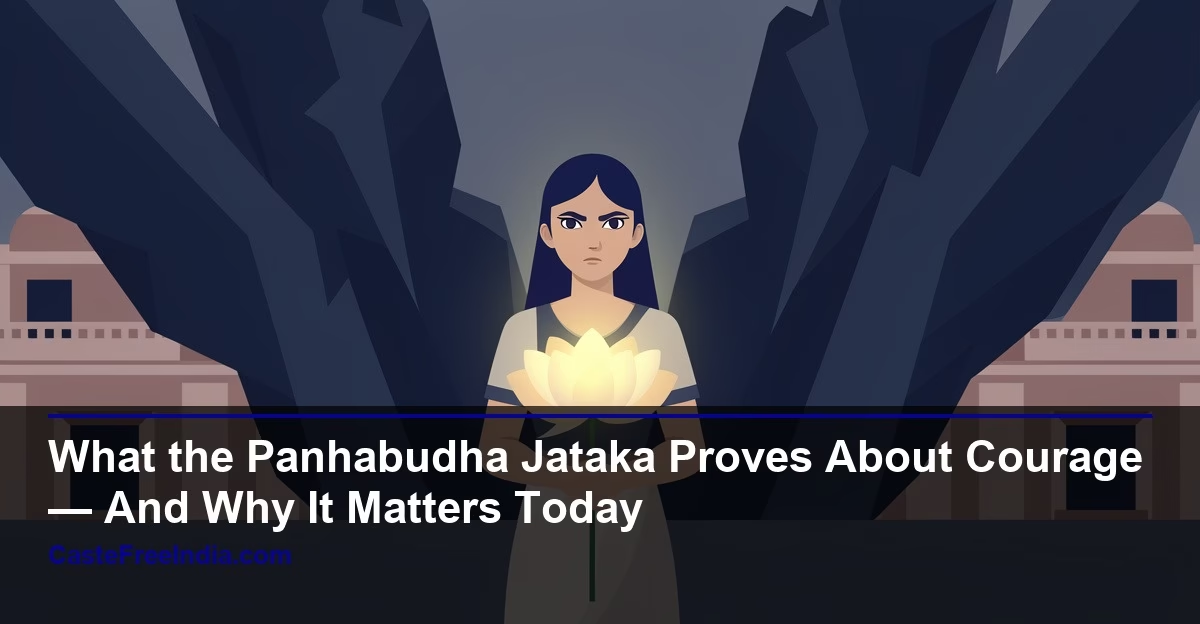
The Panchabudha Jataka: A Precursor to Angulimala’s Redemption
The story of the Buddha transforming the brutal robber Angulimala is one of the most widely known narratives from Buddhist lore. It showcases the transformative power of compassion and wisdom. However, a fascinating parallel exists in the Panchabudha Jataka, a tale from the pre-Buddha era that predates the historical Buddha himself.
This jataka offers profound insight into how the Bodhisattva, in a previous incarnation, faced a similarly violent character. He won not through divine intervention, but through sheer intellect, courage, and unwavering resolve. It poses critical questions: Can knowledge and wisdom always prevail? What happens when faced with an adversary impervious to reason? This narrative, rooted in courage, offers a powerful lesson for communities facing historical oppression, urging them never to lose hope.
Understanding the Panchabudha Jataka: Context and Meaning
We now turn our attention specifically to the Panchabudha Jataka. The term ‘Panchabudha’ itself holds layers of meaning. While ‘Pancha’ in Pali and Prakrit signifies ‘five,’ it is also linked to the name of a king, Panchabudha. Interestingly, the name ‘Punjab,’ a prominent state in India, shares its root with ‘Panchanada,’ meaning ‘land of five rivers.’
The use of ‘Pancha’ here denotes five types of skills or qualities the Bodhisattva embodies or learns. This jataka is dedicated to those on the verge of giving up, those who feel their efforts are in vain, and who have lost hope facing overwhelming systemic challenges. It is a story designed to reignite courage and perseverance when all seems lost, particularly relevant for those who feel their struggles against ingrained oppressive systems are futile.
The jatakas are often grouped thematically. The tales from 51 to 60, for instance, frequently focus on monks who have lost heart, aiming to inspire them with stories of overcoming despair. The Panchabudha Jataka fits this pattern, serving as a beacon for the disheartened. The narrative begins with a monk who has completely lost hope, declaring himself incapable of continuing his spiritual journey. This resonates with many in the Bahujan community who feel overwhelmed by the persistence of Brahmanical systems and societal inequalities, leading them to question if change is even possible. This jataka is a direct response to such sentiments, a call to arms for the spirit when it feels most depleted.
Setting the Stage: The Disheartened Monk
To initiate the teaching, the elders bring the despairing monk to the Buddha. The Buddha recounts the past life of the Bodhisattva to motivate him. The Buddha emphasizes that in past lives, individuals who faced despair but persevered ultimately achieved great rewards, even kingdoms. This sets the stage for the retelling of the Bodhisattva’s past life to inspire the disheartened monk.
The Pali Text and Historical Context: Challenging Linguistic Narratives
A line within the jataka, ‘Yo alinen chiten,’ might seem to suggest an anachronistic presence of the name ‘Ali.’ However, this interpretation is a misunderstanding. ‘Alinen’ in Pali refers to diligence or effort, not a personal name. The story, set in Jetavana, involves a monk who has lost his courage. This linguistic nuance cautions against superficial readings of ancient texts, urging deeper study into indigenous languages like Pali and Prakrit.
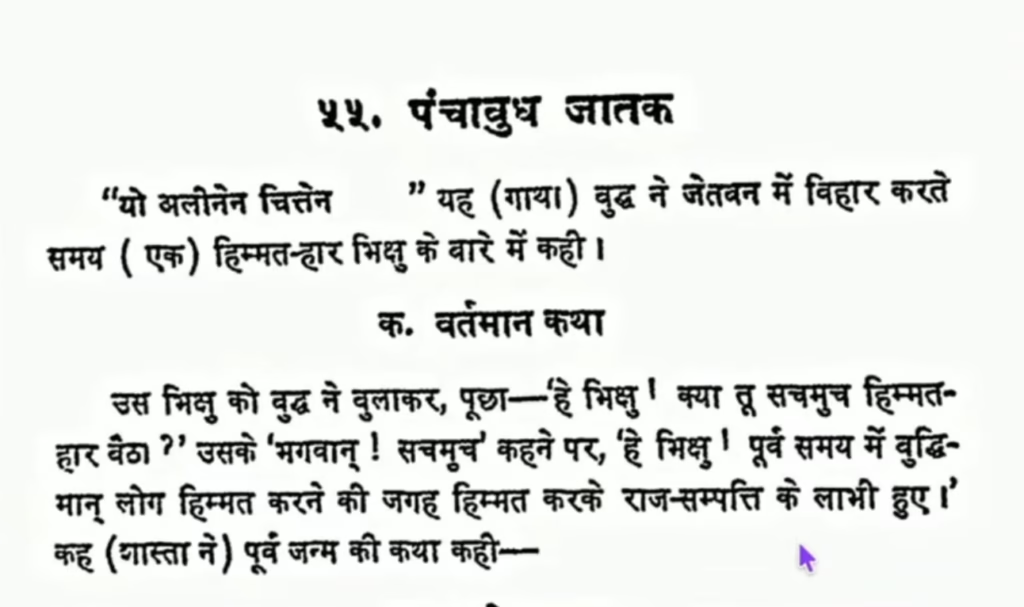
The jataka also touches upon the etymology of ‘Pancha,’ linking it to the Iranian or Persian name for Punjab. It highlights how readily Indian vocabulary has been influenced and sometimes obscured by external linguistic flows. However, the core Pali and Prakrit terms like ‘pancha’ were indigenous. The narrative cautions against attributing origins solely to external sources, emphasizing the need to reclaim and understand India’s own linguistic heritage. The story is framed within the context of the Buddha’s past lives, where the Bodhisattva often appears as a king or a prince, destined for greatness.
The Birth of Panchaputra Kumar and the Prophecy
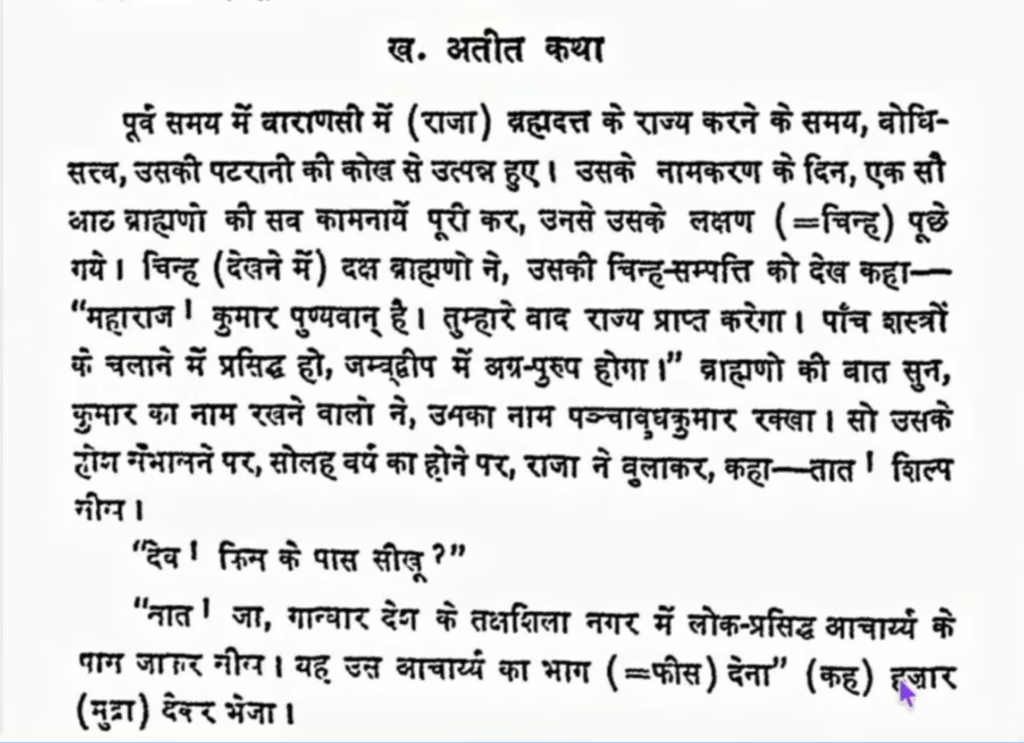
In this past life, the Bodhisattva is born as the son of King Brahmadatta. Upon his birth, 108 scholars, referred to as ‘Vamans’ (often mistranslated as Brahmins), are summoned, as was customary, to predict the child’s future. These scholars, examining the infant, prophesy that he will be highly virtuous and will become a great king, ruling over Jambudvipa (the ancient Indian subcontinent). They specifically predict his mastery over five types of weaponry, earning him the name ‘Panchaputra Kumar,’ meaning ‘son of five.’ This name reflects the pressure and expectation placed upon him from birth to excel in martial prowess. Read more: Caste Denial: How Manusmriti Ideology Distorts History
At the age of 16, as per tradition, he is sent to Taxila, a renowned center of learning at the time, to master these five weapons. After paying a substantial fee to the scholars and monks there, he diligently learns various martial arts and crafts. Upon completing his education, armed with the five weapons—representing diverse forms of combat—he sets out for Varanasi.
Encounter with Sthaliloma Yaksha: A Test of Courage
On his journey to Varanasi, Panchaputra Kumar must pass through a dense forest near Rawalpindi (present-day Pakistan), known to be inhabited by a fearsome Yaksha named Sthaliloma. The local people warn him, describing Sthaliloma as a creature that devours humans indiscriminately, and that no one has ever defeated him. They urge him to turn back. However, Panchaputra Kumar, embodying the spirit of a Bodhisattva and a prince, refuses. He asserts his training in the five arts and his duty to protect and lead. He sees it as his responsibility not to falter in the face of danger, unlike ordinary people who are prone to fear.
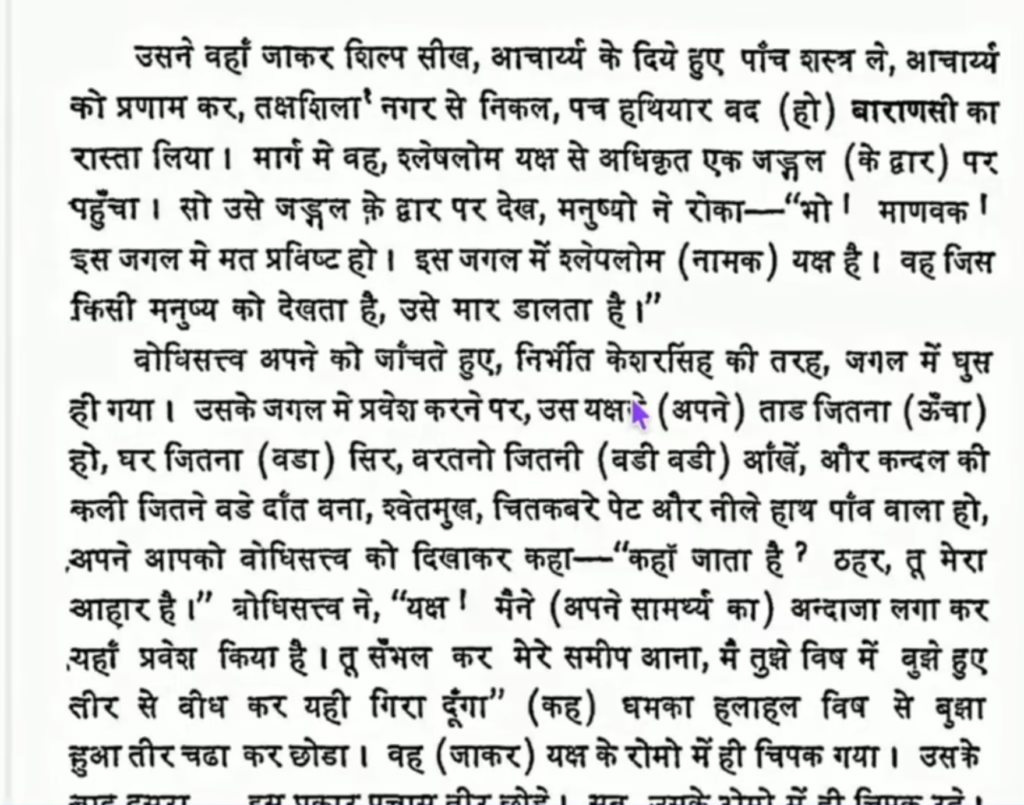
Driven by his innate fearlessness and a strong sense of duty, he enters the forest. He soon encounters Sthaliloma, a monstrous being described as being as tall as a palm tree, with a head as large as a house, eyes like large pots, teeth like buds of a kanda plant, a white complexion, a mottled belly, and blue limbs. This terrifying description draws parallels with the monstrous figures depicted in Brahmanical mythology, suggesting a common source of inspiration for such narratives.
The Battle of Wills: Weapons vs. Resolve
Sthaliloma declares Panchaputra Kumar its intended meal for the day. However, the Bodhisattva is undeterred. He warns the Yaksha that he has come prepared and that his arrows are tipped with poison. He fires his arrows, but they inexplicably stick to the Yaksha’s skin without penetrating. Undeterred, he draws his 33-finger-long sword, but it too adheres to the Yaksha’s body upon striking.
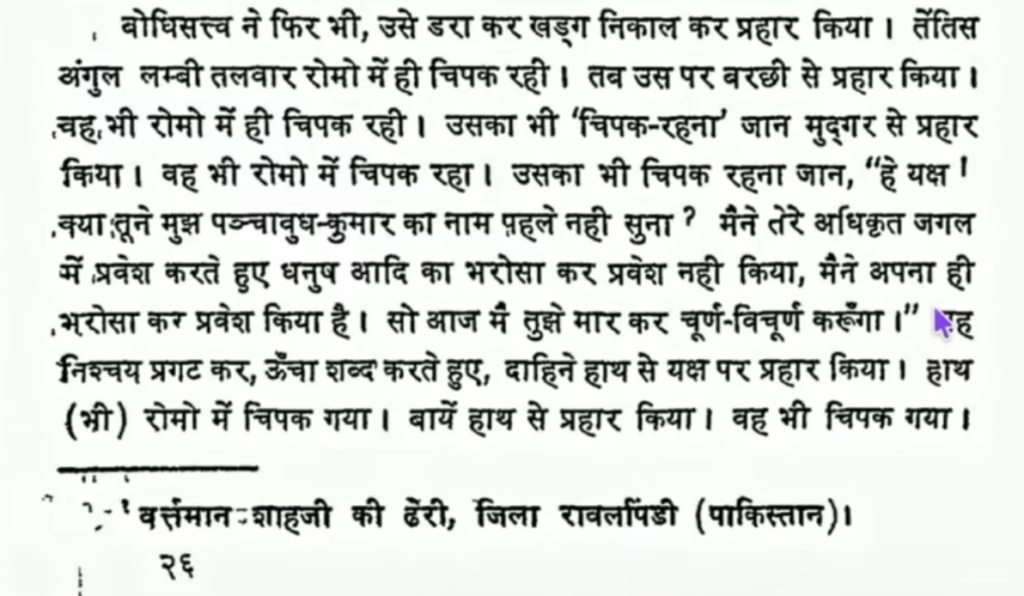
Next, he employs a spear, which also fails to pierce the creature. He then uses a mace, only for it to stick to the Yaksha. Finally, he resorts to martial arts, attacking with his fists and feet, but each limb he uses also gets stuck to the Yaksha’s body. Even when he attempts to strike with his head, it too becomes entangled.
Despite being completely immobilized, bound by the Yaksha’s supernatural grip, Panchaputra Kumar remains fearless. This is the crux of the story: the unwavering courage in the face of utter defeat. The Yaksha, accustomed to striking terror into all humans, is astonished by the Bodhisattva’s resilience. He remarks that humans usually flee or succumb to fear after a single weapon fails. This individual, however, fights relentlessly, displaying an extraordinary level of confidence even when bound. The Yaksha begins to perceive him not as an ordinary man, but as a ‘lion among men,’ someone who embodies ultimate courage.
The Turning Point: Fearlessness as the Ultimate Weapon
The Yaksha, deeply perplexed by the Bodhisattva’s lack of fear, questions him. Panchaputra Kumar explains that he entered the forest not relying on his weapons, but on his self-belief and the inherent strength within him. He asserts that he came to defeat the Yaksha, and even if he were to die, he would take the Yaksha with him. He reveals that he carries a ‘Vajra’ (thunderbolt) within him, implying his inner strength and determination are so potent that they could destroy the Yaksha, even if it meant his own demise. This concept of an inner ‘Vajra’ symbolizes the unshakeable resolve derived from profound knowledge and self-awareness.
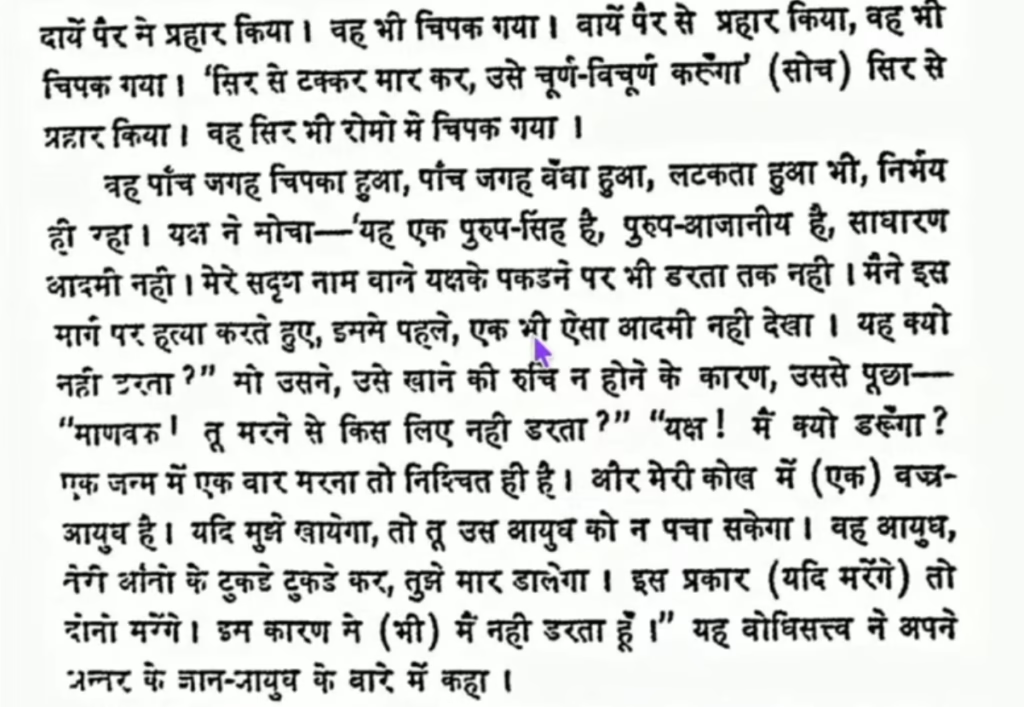
The Yaksha, hearing this, realizes the truth in the Bodhisattva’s words. He acknowledges that he cannot digest even a morsel of flesh from the Bodhisattva, as his inner strength is immense. For the first time, the Yaksha experiences fear. This moment is pivotal: the oppressor, for the first time, feels threatened not by physical might, but by the sheer indomitable spirit of the oppressed. This mirrors historical struggles where communities, despite facing brutal subjugation, found strength in their shared identity and unwavering resolve, eventually forcing their oppressors to reconsider their tactics.
Lessons from the Encounter: Wisdom, Karma, and Transformation
Recognizing the Bodhisattva’s superior courage and inner strength, the Yaksha releases him. He admits that he has never encountered a human like him, one so fearless and resolute. He offers to let the Bodhisattva go, advising him to live happily with his kin. The Bodhisattva, however, does not leave without imparting wisdom. He reminds the Yaksha of his harmful actions and the karmic consequences of his deeds—the suffering he has caused, leading to rebirths in hellish realms, as an animal, a ghost, or a demon.
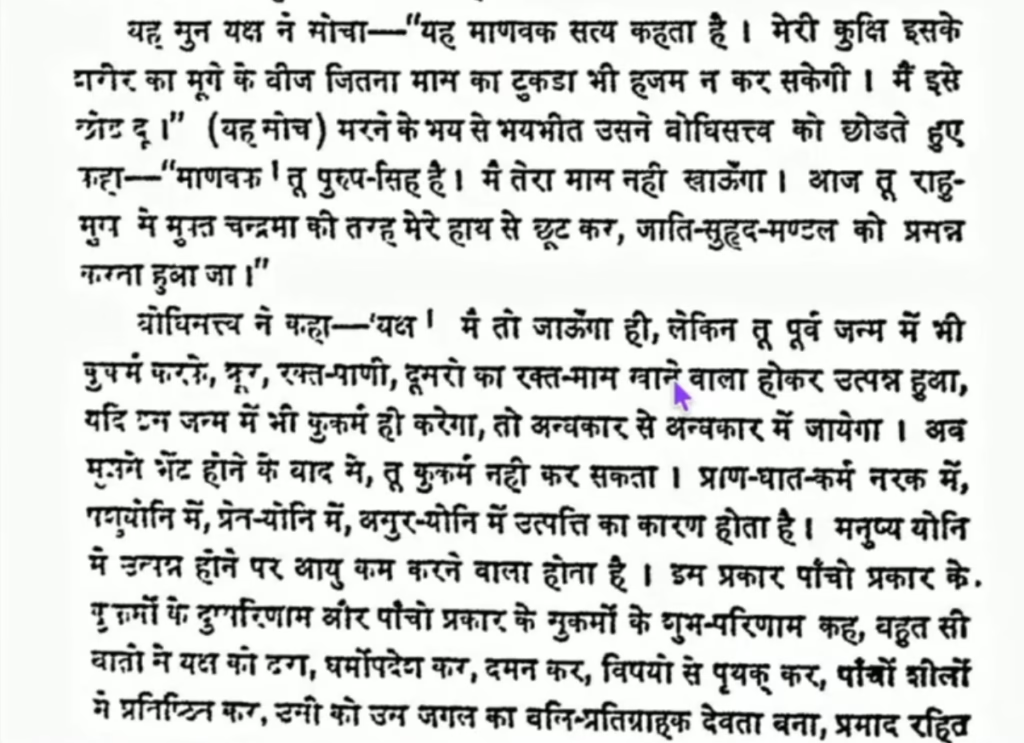
Then he proceeds to teach the Yaksha about the results of both good and bad karma. He elaborates on the fivefold path of righteous conduct and the benefits of virtuous actions, contrasting them with the severe repercussions of evil deeds. The Bodhisattva uses the principles of the Five Precepts (Pancha Sheela) to guide the Yaksha towards a path of righteousness and self-control, urging him to become a protector of offerings and to live diligently. This act of teaching the oppressor highlights the Buddhist principle of universal compassion and the belief in the possibility of transformation for all beings. Read more: Ambedkar’s 22 Vows and Buddhism: Path to Equality
Reclaiming Terminology: Beyond Brahmanical Distortion
The jataka serves as a crucial reminder of how Brahmanical traditions have attempted to co-opt and distort Buddhist terminology (the systematic misrepresentation of indigenous concepts by Brahminical interpretations). The text explicitly refutes the common Brahmanical interpretation of terms like ‘Smriti’ (mindfulness). It clarifies that Buddhist ‘Smriti’ refers to the four foundations of mindfulness: contemplation of the body (kayanupassana), feelings (vedananupassana), mind (chittanupassana), and mental objects (dhammanupassana). This is contrasted with the Brahmanical concept, often associated with Manusmriti, which is presented as a distortion aimed at undermining Buddhist teachings. Read more: Deep Roots of Conspiracy Theories in Indian History
Similarly, terms like ‘Rishipatha’ (path of sages), ‘Bodhi-Paksika’ (factors of enlightenment), and the ‘Arya Ashtanga Marga’ (Noble Eightfold Path) are explained in their authentic Buddhist context. The text criticizes the appropriation and misrepresentation of these terms by what it calls the ‘Chunmanga Gang,’ suggesting a deliberate effort to replace genuine Buddhist concepts with Brahmanical equivalents. The presence of 108 scholars at the Bodhisattva’s birth is also highlighted, drawing a parallel to the scholars present at the birth of the historical Buddha, questioning the Brahmanical claim of exclusivity and emphasizing the shared intellectual heritage.[source]
The Moral of the Story: Courage, Resilience, and Transformation
Upon his return to Varanasi, Panchaputra Kumar recounts his encounter with Sthaliloma to his parents. He eventually ascends to the throne and rules justly. The story concludes with a verse that encapsulates its essence: any person who diligently cultivates wholesome qualities with enthusiasm, striving for liberation (Arhatship or Nirvana), will, in due course, attain the cessation of all fetters.
The Panchabudha Jataka, much like the Angulimala story, emphasizes the possibility of transformation. However, it highlights the critical role of inner strength and unwavering courage. While Angulimala was transformed by the Buddha’s direct intervention, Panchaputra Kumar achieved his victory through his own inherent fearlessness and self-belief. This narrative resonates deeply with the idea that true strength lies not in external power but in inner fortitude. It teaches that even when faced with overwhelming odds and seemingly insurmountable challenges, maintaining one’s resolve can lead to overcoming fear and achieving a higher state of being.
What Can You Do?
The Panchabudha Jataka offers profound lessons on courage, perseverance, and the power of self-belief. As inspired by the Bodhisattva’s journey:
- Cultivate Inner Strength: Draw inspiration from the Bodhisattva’s unwavering resolve. Recognize that true courage comes from within, not from external validation or weaponry.
- Never Lose Hope: In the face of systemic oppression or personal despair, remember that giving up is not an option. Like the Bodhisattva, continue to strive and believe in your ability to overcome challenges.
- Embrace Knowledge and Wisdom: Understand that intellectual and moral strength are powerful tools. Educate yourself and use your knowledge to navigate and challenge oppressive structures.
- Challenge Distorted Narratives: Be critical of information that seeks to misrepresent or appropriate historical and spiritual traditions. Reclaim and understand the authentic meanings behind terms and stories.
- Share the Wisdom: Discuss these stories and their lessons with your community. Inspire others to cultivate courage and resilience, fostering a collective spirit of hope and determination.
Disclaimer
- Jataka: A collection of tales about the previous lives of the Buddha, offering moral and ethical lessons.
- Bodhisattva: A being who is on the path to becoming a Buddha, dedicated to the enlightenment of all sentient beings.
- Brahmanism: The religious and social system that preceded and influenced Hinduism, characterized by a caste hierarchy and Vedic rituals.
- Bahujan: Literally meaning ‘majority of people,’ referring to the oppressed castes and marginalized communities in India.
- Pali and Prakrit: Ancient Indian languages in which early Buddhist texts were written.
- Taxila: An ancient center of learning, renowned for its university, located in modern-day Pakistan.
- Yaksha: A class of nature spirits, often depicted as powerful and sometimes fearsome beings in ancient Indian literature.
- Karma: The principle of cause and effect, where actions have consequences in this life and future lives.
- Pancha Sheela: The Five Precepts, a basic code of ethical conduct for Buddhists: abstaining from killing, stealing, sexual misconduct, lying, and intoxicants.
- Smriti: In Buddhism, refers to mindfulness or awareness. In Brahmanism, it refers to remembered tradition, such as Manusmriti.
Do you disagree with this article? If you have strong evidence to back up your claims, we invite you to join our live debates every Sunday, Tuesday, and Thursday on YouTube. Let’s engage in a respectful, evidence-based discussion to uncover the truth. Watch the latest debate on this topic below and share your perspective!

Skeptical Indian is an independent researcher documenting
caste discrimination through primary sources, Hindu
scriptures, court records, and government data.
CasteFreeIndia.com has published 100+ evidence-based
analyses since 2024.