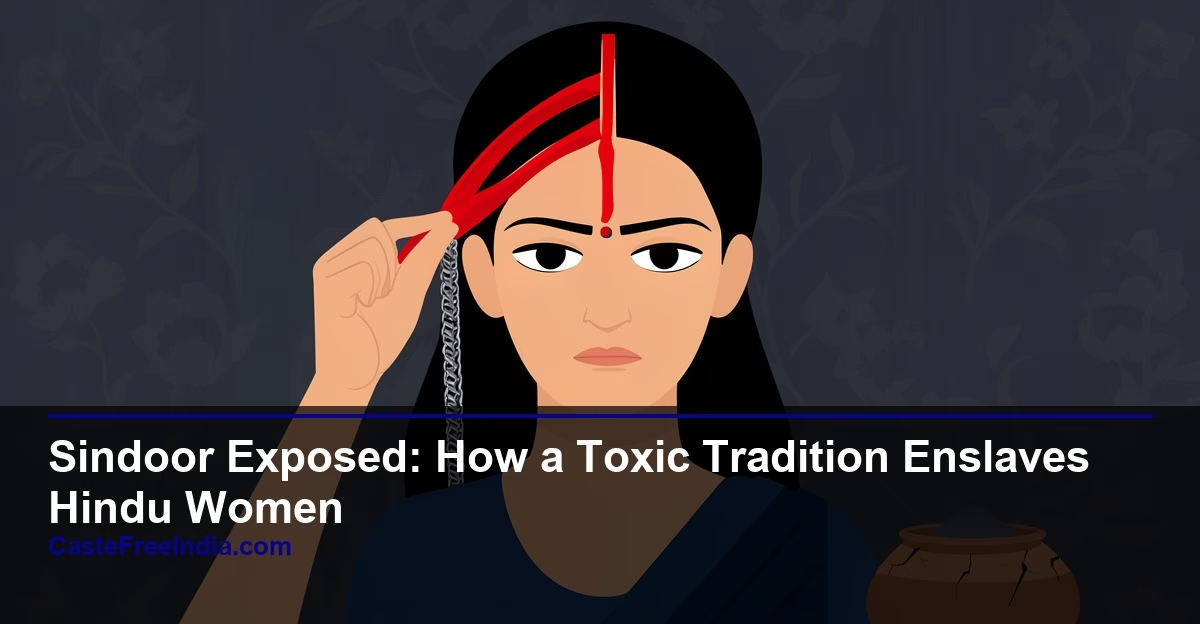
This article exposes the truth about sindoor, a toxic tradition that enslaves Hindu women. Rooted in Brahminical patriarchy and lacking scriptural basis, sindoor is a harmful chemical used to mark women as property. We examine its origins in Aryan fire worship, its toxic chemistry, and its role in women’s oppression. By understanding this history, women can break free from the sindoor chain. Read more: A Rational Look at Karwa Chauth: Origins, Rituals, and Societal Impact
The Sixteen ‘Adornments’ — Or Sixteen Shackles?
Hindu scriptures prescribe solah shringar (sixteen adornments) for married women, including sindoor, bangles, and anklets. However, these ‘adornments’ are prescribed solely for the purpose of sexual arousal and objectification of women. The texts often link their significance to how they make a man feel, not to female empowerment. Therefore, the woman is reduced to a ‘thing’ — an object of use. This objectification leads to domestic violence, dowry deaths, and systemic oppression. The most prominent of these ‘adornments’ is sindoor, falsely considered a symbol of married happiness.
The Real Color of Sindoor, Fire, Not Love
The bright red sindoor seen today is not original. The original sindoor was the same shade as the vermilion applied to Hanuman’s body and used in temples. This red is the color of fire — a symbol of Aryan culture. The Aryans adopted fire as their emblem. The tilak on men’s foreheads and the sindoor in women’s hair are both markers of this fire-worshipping culture. The word ‘sindoor’ (सिंदूर) derives from ‘Sindhu’ (country) and ‘ur’ (excellent), meaning ‘the excellent people of the Sindhu region’ — the Aryans who declared themselves superior. By applying sindoor, Hindu women unwittingly brand themselves with a racial supremacist ideology.[source][source]
“The word ‘sindoor’ (सिंदूर) can be broken down as ‘Sindhu’ + ‘ur’. ‘Sindhu’ means ‘country’ and ‘ur’ means ‘excellent’. So, sindoor literally means ‘the excellent people of the Sindhu region’ — the Aryans who declared themselves superior.”
The Poisonous Chemistry of Sindoor
From a scientific perspective, sindoor is primarily red lead (lead tetroxide) or mercury sulfide. The manufacturing process involves heating lead to 470°C to produce the red powder. It also contains chromium, lead, and mercury. If ingested, a pinch of sindoor can destroy your voice permanently or even cause death. Applying it daily on the skin leads to lead poisoning, causing neurological damage, infertility, and cancer. The same chemical is used in paints, batteries, and matches. Would you apply paint on your skin every day? Yet Hindu women do this willingly, in the name of tradition.[source]
The ‘Kumkum’ Myth
Some argue that natural kumkum (made from turmeric and lime) is different. However, what is sold as sindoor in the market is almost always adulterated with lead and other heavy metals to give it a bright, lasting color. Even natural kumkum is often mixed with chemicals to make it ‘stay’ on the hair parting.
The Historical Lie: Sindoor as a ‘Sacred’ Hindu Tradition
A common argument is that sindoor has been part of Hindu weddings since ancient times. Nevertheless, evidence proves otherwise.
No Vedic or Puranic God Used Sindoor in Weddings
When we look at the weddings of Hindu gods, there is no sindoor ceremony. Ram married Sita by garlanding her. Krishna married Rukmini through a gandharva (love) marriage, also with garlands. Shiva married Parvati by garlanding her. Brahma marrying Saraswati, Vishnu receiving Lakshmi — no sindoor anywhere. The only ritual mentioned is the saptapadi (seven steps). Sindoor is completely absent in all divine weddings. Read more: How Buddhist Sculptures Are Brahmanized in Plain Sight
Buddhist Evidence: Maang Tilak, Not Maang Sindoor
Even in Buddhist texts, sindoor was applied as a tilak on the forehead, not in the hair parting. The transcript cites Ashwaghosha’s Buddhacharita, which describes Princess Yashodhara’s wedding: she was adorned and then a sindoor tilak (vermilion mark) was placed on her forehead. This proves that in ancient times, the practice was tilak, not filling the maang (hair parting). Moreover, in Buddhacharita, when Siddhartha and Yashodhara were married, they applied a tilak on the forehead, not sindoor in the hair parting.[source]
“In Buddhacharita, when Siddhartha and Yashodhara were married, they applied a tilak on the forehead, not sindoor in the hair parting.”
So how did the practice of filling the maang with sindoor begin?
The Real History: How Sindoor Entered Women’s Hair
The shift from forehead tilak to maang sindoor is linked to two major historical events: foreign invasions and Brahminical control.
Protection from Invaders
During invasions by Mughals and other foreign armies, women were often abducted and raped. To protect upper-caste women, Brahmins introduced the practice of filling the maang with sindoor. The idea was that a woman with sindoor in her hair would be recognized as married, and invaders would spare her out of ‘respect’ for local customs. This is why the practice became especially strict among the savarna (upper caste) women.
Branding Women as Property
Moreover, there is a darker reason. Once a woman had sindoor in her hair, she was marked as the property of one man. Sindoor is a symbol of slavery. Just as a dog is marked by its owner, a Hindu woman is marked by her husband. Until she wears sindoor, there is doubt about who owns her. Sindoor removes that doubt. This is why widows are forced to remove sindoor — because their ‘owner’ has died. The practice is not about love or beauty; rather, it is about control and ownership.
The Devadasi Connection: Sindoor as a Marker of Prostitution
The most shocking revelation is the connection between sindoor and the Devadasi system.
Devadasis: ‘Married’ to Gods
Under the Devadasi system, young girls were married to temple deities and then sexually exploited by Brahmin priests. During this ‘wedding,’ the girl’s forehead was marked with sindoor tilak to signify she was ‘married’ to the god. However, since the god was a stone statue, the real ‘husbands’ were the priests. The sindoor thus became a brand of temple prostitution. Devadasis always wore a sindoor tilak on their foreheads, identifying them as the ‘wives’ of the temple deity — and the concubines of the Brahmin priests.
“Devadasis always wore a sindoor tilak on their foreheads. It identified them as the ‘wives’ of the temple deity — and the concubines of the Brahmin priests.”
Thus, sindoor, originally a tilak, became associated with a woman’s availability for sexual exploitation. Over time, the practice moved from the forehead to the maang, and it became a universal symbol of marriage — a blatant lie manufactured by the priestly class.
Hindu Women: The Original ‘Slaves’
Hindu scriptures openly advocate for the enslavement of women. The transcript quotes from Manusmriti and Tulsidas’s Ramcharitmanas.
Manusmriti on Women
The following verses from Manusmriti reveal the Brahminical view of women:
“A woman is never fit for independence. She must be controlled by her father in childhood, by her husband in youth, and by her son in old age.” (Manusmriti 9.3)
“Women have no right to Vedic mantras. They have no right to perform any religious rituals.” (Manusmriti 2.67)
“The giver of a daughter who is a virgin is the only one who gives. A woman is like property; she can be given away only once.”
Tulsidas on Women
Tulsidas, author of the Ramcharitmanas, wrote:[source]
“Dhol, ganwar, shudra, pashu, nari — ye sab tadan ke adhikari.” (Drums, illiterates, shudras, animals, and women — all these deserve to be beaten.)
With such a mindset ingrained in religious texts, it is no wonder that women are forced to wear sindoor as a mark of their servitude. The practice is not a sweet tradition — it is a weapon of oppression.
Who Benefits from Sindoor?
The answer is clear: Brahmin priests and the patriarchal system. By keeping women in a state of mental slavery, they ensure that women will continue to follow rituals without questioning them. Women are conditioned to believe that their husband’s life depends on sindoor. This creates fear, which makes them obedient. Read more: Menstrual Leave: Biological Necessity Over Equality
The Global Context: Only 3 Countries
It is often believed that married women everywhere apply sindoor. The truth is that only three countries in the world have this practice: India, Nepal, and Bangladesh. Even in Nepal, it is only practiced by certain Hindu communities. In the other 263 countries of the world, women do not feel the need to ‘prove’ their marriage through a red chemical on their scalp. This alone demonstrates that sindoor is a cultural construct, not a universal symbol.
Why Men Do Not Wear a Similar Mark
If sindoor is truly a symbol of marriage, why do men not wear it? Why is there no male equivalent? The answer is power. Marriage is supposed to be a partnership, but in Hindu tradition, it is a one-sided ownership. The man does not need to be ‘marked’ because he is the owner, not the owned. The woman is the property, so she must bear the brand.
A Call for a Fair Marriage Symbol
The transcript suggests a radical idea: if sindoor must exist, men should also wear it. If a man is truly committed to his wife, he should be willing to display that commitment on his own body. However, men will never accept this, because it would expose the hypocrisy. The author proposes that instead of an oppressive symbol, the focus should be on mutual respect and constitutional equality.
Conclusion: Break the Sindoor Chain
Sindoor is not a sacred tradition. It is a toxic, patriarchal brand that has been forced on Hindu women for centuries and it has no basis in the Vedas or in the weddings of Hindu gods. It is a later invention by Brahmins to protect their women from invaders and, more importantly, to control women as property and it is a poisonous powder that damages health and reinforces mental slavery. Women who wear it are unknowingly participating in a system that devalues them. It is time to reject sindoor and break free from this chain of mental slavery.
What Can You Do?
If you are a woman, stop wearing sindoor. Educate yourself and others about its toxic history and chemistry. If you are a man, support your wife, sister, or mother in giving up this harmful practice. Do not force it on your bride. Instead, build a relationship based on equality, not ownership. Share this article with everyone you know. Let us build a caste-free, gender-equal India where no one is branded by a poisonous powder.
Frequently Asked Questions
1. Is sindoor mentioned in the Vedas?
No, sindoor is not mentioned in the Vedas. The practice of applying sindoor in the hair parting is a later addition, not a Vedic ritual.
2. Is sindoor harmful to health?
Yes, commercial sindoor contains toxic heavy metals like lead and mercury, which can cause lead poisoning, neurological damage, infertility, and cancer with regular use.
3. Why do widows remove sindoor?
Widows remove sindoor because it symbolizes ownership by their husband. When the husband dies, the ‘owner’ is gone, so the mark is removed. This underscores the patriarchal control behind the practice.
4. Did Hindu goddesses wear sindoor?
No. In Hindu mythology, goddesses like Sita, Rukmini, and Parvati married without any sindoor ceremony. The practice is absent in divine weddings.
5. Can men wear sindoor too?
There is no tradition of men wearing sindoor. Some activists suggest that if sindoor is a true symbol of marriage, men should also wear it, but this is rarely practiced due to patriarchal norms.

Skeptical Indian is an independent researcher documenting
caste discrimination through primary sources, Hindu
scriptures, court records, and government data.
CasteFreeIndia.com has published 100+ evidence-based
analyses since 2024.