Unveiling the Rigveda: A Foundation of Brahmanism and Its Controversial Narratives
The Rigveda, considered one of the most sacred texts in Brahmanism, contains narratives that have sparked considerable debate and scrutiny, particularly concerning the origins and conduct of its revered figures. This exploration aims to delve into specific hymns and their interpretations, focusing on the controversial accounts of the birth of sages, the interactions between divine beings and mortals, and the societal implications of these ancient stories. Our objective is to encourage a scientific temperament and critical thinking when engaging with these foundational texts. This analysis will present textual evidence from the Rigveda, shedding light on passages that describe events and relationships in ways that appear unusual or even obscene by modern standards.
Does this text truly represent a singular, divinely inspired truth, or is it a complex tapestry woven over centuries, reflecting evolving societal norms, philosophical ideas, and perhaps even biases? By dissecting specific passages, we aim to foster an informed and rational discourse, moving beyond uncritical acceptance.
Table of Contents:
- The Fifth Mandala: Urvashi and the Birth of Rishis
- The Social and Cultural Context of the Rigveda
- Contradictions and Anachronisms: Vashishtha, Vishwamitra, and Textual Layers
- Allegations of Obscenity and Erotic Content in the Rigveda
- Anomalies in Agastya's Life: The Lopamudra Dialogue and Textual Jumps
- Conclusion: Critical Engagement with Sacred Texts
The Fifth Mandala: Urvashi and the Birth of Rishis
One of the most discussed narratives revolves around the birth of sages Vashishtha and Agastya. According to certain interpretations of the Rigveda, their origin is linked to the celestial nymph Urvashi and the deities Mitra and Varuna. The account suggests that upon observing Urvashi, Mitra and Varuna experienced a semen emission, which was then collected in a pot. From this pot, Agastya was born, and it is often implied that Vashishtha shares a similar origin. This narrative, as presented in the texts, raises questions about the methods of procreation and the symbolic meanings embedded within these ancient tales.

The explicitness of the description, especially in relation to the deities’ physical reactions, has led to its classification as a potentially obscene account. The intention behind such descriptions in a sacred text remains a subject of interpretation, with some scholars suggesting allegorical meanings while others point to a literal, albeit unconventional, depiction of divine or semi-divine origins. Why was it necessary to include such explicit descriptions of the birth of sages? Were these sages mythical figures, or were these narratives intended as mockery? What was the underlying purpose driving the inclusion of such content within these revered texts?
Urvashi’s Multifaceted Role: From Nymph to Muse
Urvashi is depicted in the Rigveda not merely as a passive observer but as an active participant in the lives of gods and sages. In Mandala 5, Sukta 41, she is mentioned in conjunction with Ila, a figure associated with abundance and sustenance. The hymn describes Ila and Urvashi collectively bestowing blessings and praising the sacrifices of the ‘yajamana’ (the patron of the sacrifice).

This portrayal highlights Urvashi’s significance as a celestial dancer and enchantress, whose presence and actions influence the divine and mortal realms. Her interactions, as detailed in various hymns, often involve complex relationships with sages and gods, contributing to the rich tapestry of Vedic mythology. The enigmatic nature of Urvashi, oscillating between divine allure and mythical agency, makes her a compelling figure in understanding the cosmogony and the symbolic language of the Rigveda.
Urvashi and Pururavas: A Myth of Love, Loss, and Sexuality
Further intertwining the narrative of Urvashi is her relationship with Pururavas, often referred to as ‘Puranva’ or ‘Purva’ in translations. The dialogue between Pururavas and Urvashi, prominently featured in Mandala 10, Sukta 95, presents a poignant yet controversial story of love, separation, and cosmic misunderstanding.
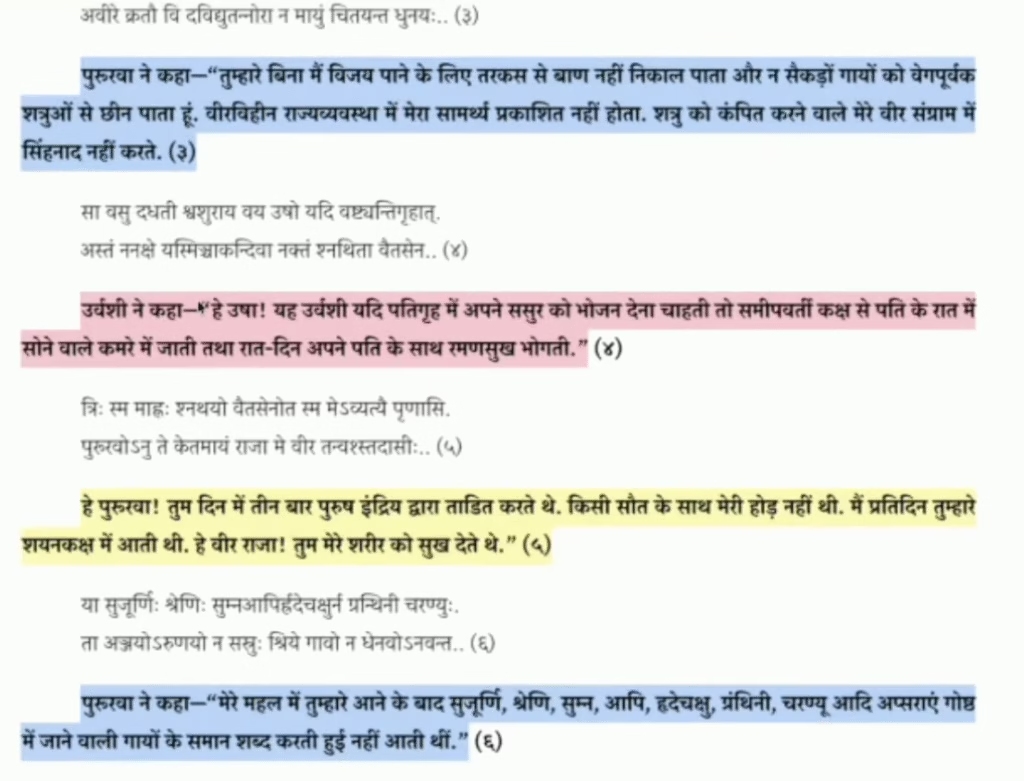
Pururavas, a mortal king, pleads with Urvashi, the celestial nymph, to stay with him, lamenting that life without her is unbearable and hinders his ability to perform heroic deeds like acquiring cattle.
Urvashi, however, emphasizes her ethereal nature, comparing herself to the wind and stating her inability to remain bound to the mortal world. This exchange, rich with emotional undertones, also contains descriptions of their physical intimacy and the eventual parting, contributing to the perception of explicit content within the sacred text. The duration of Urvashi’s stay with Pururavas, reportedly four years, and the descriptions of their union, are often cited as examples of the text’s unconventional approach to divine-mortal relationships.
Pururavas’s Plea and Urvashi’s Departure
Pururavas desperately implores Urvashi to remain, confessing that his existence feels hollow and his capacity for valor diminishes without her presence. Urvashi, in turn, explains her transient nature, likening herself to the wind and asserting her inability to be tethered to the mortal realm. This dialogue, deeply emotional, also includes explicit references to their physical union and their eventual separation. These elements contribute to the perception of explicit content within the sacred text, highlighting the text’s unconventional depiction of divine-mortal relationships.
The Allegations of Adultery and Female Deception
The hymn also touches upon accusations of Urvashi’s infidelity and her stark comparison of women’s hearts to those of wolves, portraying them as inherently deceitful and untrustworthy. This perspective, presented within a sacred text, has been interpreted as a reflection of patriarchal attitudes prevalent during the period of its composition.
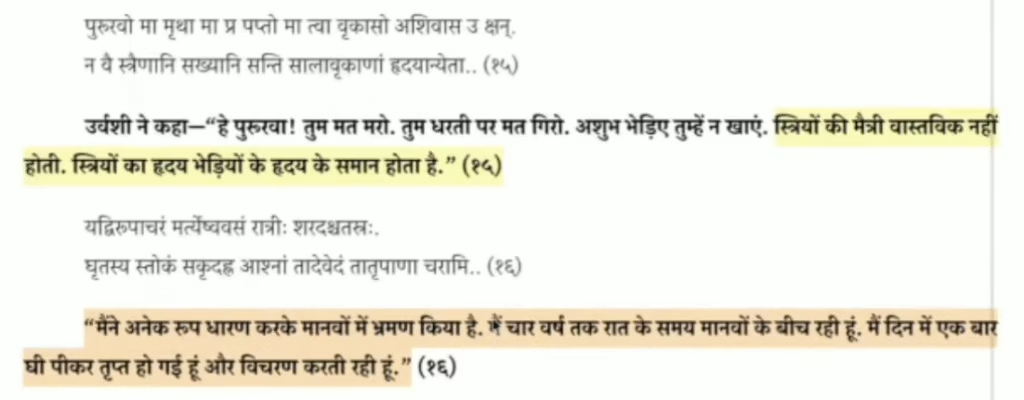
These passages have led to accusations that the Rigveda, in its attempts to explain cosmic phenomena or divine relationships, resorted to sexually explicit language and narratives, which could be considered inappropriate for a sacred text. It suggests that such content might have contributed to the practice of not reading these scriptures in front of women, as alluded to by Al-Biruni, who noted that certain religious texts were considered forbidden for female audiences.
The Social and Cultural Context of the Rigveda
The Rigveda, while ancient, offers glimpses into social structures and cultural practices that challenge modern understanding. The text frequently mentions deities like Mitra and Varuna, who are often depicted acting in unison, performing actions that are interpreted as symbolic or literal. Their role in the birth of sages, as detailed earlier, exemplifies how divine intervention and unconventional biological processes are woven into the fabric of Vedic belief.
The text also refers to various social groups and practices, such as the mention of ‘yajamanas’ and their sacrifices, underscoring the importance of ritualistic performances in ancient Vedic society. The perceived ‘ चापलूसी’ (flattery) directed towards deities in the hymns, requesting acceptance of ‘srot’ (sources) and ‘namaskar’ (salutations), reflects a devotional and supplicatory relationship between humans and the divine, aiming to secure divine favor and protection. This dynamic highlights the hierarchical structure inherent in the Vedic worldview, where humans sought blessings and support from powerful, often anthropomorphic, deities.
The Concept of ‘Shruti’ and Oral Transmission
The term ‘Shruti,’ often translated as ‘that which is heard,’ is central to the concept of Vedic scriptures. It implies a tradition of oral transmission, where knowledge and sacred texts were passed down through generations by word of mouth. The nature of this ‘Shruti,’ akin to passing information verbally, prompts questions about its integrity and accuracy over millennia. The hymns themselves, when analyzed, reveal linguistic features and phonetic sounds like ‘Ri,’ ‘Kh,’ and ‘Tr,’ which are argued to have appeared in India much later. The presence of these sounds in the Rigveda is used to question the commonly accepted timelines of its composition, suggesting that the text, in its current form, might incorporate elements from different historical periods.
The Caste System and Early Vedic Society
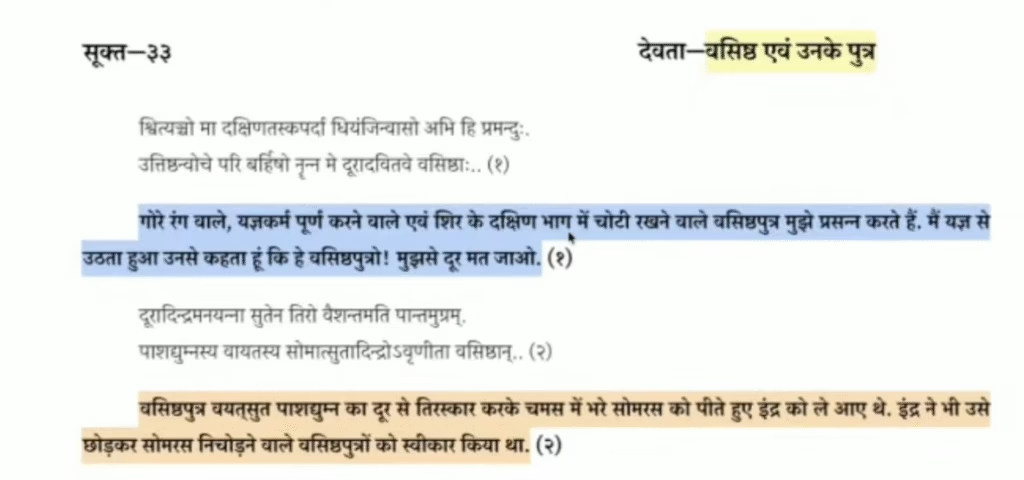
While the Rigveda predates the formalized caste system as understood in later periods, it does contain elements that hint at social stratification and occupational differentiation. The hymn discussing Vashishtha and his sons, for instance, mentions their involvement in battles and their divine protection of King Sudas. This indicates a priestly class (Vashishtha and his lineage) intertwined with the warrior class (the king and his army). The text also touches upon racial or color distinctions, using phrases like ‘गोरे रंग वाले’ (fair-skinned ones) when referring to the sons of Vashishtha.
This usage, while not explicitly defining a caste hierarchy, points to a consciousness of physical differences that may have played a role in social organization. The debate about when certain practices, like the ‘choti’ (tuft of hair) worn by Brahmins, became prevalent is also raised, questioning their presence in the very early Vedic period based on the absence of such mentions in other contemporary or slightly later traditions like Buddhism. The mention of ‘Mleccha,’ a term often used for foreigners or those outside the Vedic fold, further illustrates the evolving social landscape and the definitions of ‘insiders’ and ‘outsiders’ within ancient Indian society.
Contradictions and Anachronisms: Vashishtha, Vishwamitra, and Textual Layers
A significant point of contention arises when comparing the narratives in the Rigveda with those found in later epics like the Ramayana. The Rigveda’s depiction of Vashishtha’s sons participating in the Dasharajna war, fighting alongside King Sudas, presents a different historical context than the Ramayana’s account. In the Ramayana’s Balakanda, Vashishtha’s sons, numbering a hundred, are said to have been killed by Vishwamitra. This stark difference in the portrayal of Vashishtha’s lineage and his interactions with Vishwamitra leads to questions about the chronological layering of these texts.
If the Ramayana’s version is considered, then the Rigvedic account, which predates the Ramayana in its current scholarly understanding, presents a historical or mythological inconsistency. The text also touches upon the story of Trishanku, a king cursed by Vashishtha and uplifted by Vishwamitra, illustrating the complex relationships and power dynamics between sages and royalty, and the role of caste in these interactions. The perceived inconsistencies and anachronisms fuel the argument that these texts may have been composed or redacted over long periods, incorporating stories and traditions from various eras.
The Significance of the ‘Choti’ and Historical Evidence
The practice of wearing a ‘choti’ (a tuft of hair at the back of the head) is presented as a distinctive marker, specifically associated with the sons of Vashishtha in one Rigvedic passage. However, there is no clear historical evidence to suggest its prevalence in ancient India, particularly within Buddhism. References to travelers and scholars like Faxian, Megasthenes, and Xuanzang are cited, who documented their observations of Indian society.
None of these accounts, according to critical analysis, mention the practice of wearing a ‘choti’ among Brahmins or any other group. This absence of evidence is used to argue that the ‘choti’ tradition might be a later development, and its attribution to early Vedic sages in the Rigveda is therefore questionable. Ancient Indian traditions, including Buddhism, often favored clean-shaven appearances, further undermining the claim of early ‘choti’ adherence.
Dating the Texts: A Contentious Issue and Linguistic Clues
The dating of Vedic texts, including the Rigveda, is a deeply contentious issue with scholars offering widely divergent timelines. While some traditionalists suggest ages running into millions of years, others propose dates around 3,500 years ago, or even later. These claims are often critiqued as ‘गपिया’ (tall tales) and highlight apparent chronological discrepancies within the texts themselves and in relation to external historical evidence.
The presence of linguistic elements like the ‘shr’ sound, which is argued to be a later development, is presented as an example of an anachronism that challenges the purported antiquity of the Rigveda. A systematic comparison of different Vedic and post-Vedic texts would reveal significant inconsistencies in their timelines, leading to a more accurate understanding of their composition and evolution. The lack of a consistent and verifiable dating methodology for these ancient scriptures is thus presented as a major obstacle to their objective interpretation.
Allegations of Obscenity and Erotic Content in the Rigveda
The Rigveda, despite its sacred status, contains hymns that are described as explicit and obscene. The dialogue between Pururavas and Urvashi in Mandala 10, Sukta 95, is a prime example. The conversation includes references to their intimate relationship, and explicit descriptions of their physical encounters. Urvashi’s statement about Pururavas’s desire and actions is particularly graphic. The hymn also mentions Pururavas’s boasts of acquiring hundreds of cows from enemies, suggesting a lifestyle that included raiding and warfare, intertwined with his romantic pursuits.
The text describes Urvashi’s supposed infidelity and her comparison of women’s hearts to those of wolves, portraying them as deceitful and untrustworthy. These passages have led to accusations that the Rigveda, in its attempts to explain cosmic phenomena or divine relationships, resorted to sexually explicit language and narratives, which could be considered inappropriate for a sacred text. The transcript suggests that such content might have contributed to the practice of not reading these scriptures in front of women, as alluded to by Al-Biruni, who noted that certain religious texts were considered forbidden for female audiences.
The Portrayal of Women and Gender Dynamics
The Rigvedic portrayal of women, particularly in the context of their relationships with sages and deities, is complex and often controversial. Urvashi, the celestial nymph, is depicted as an alluring but ultimately unattainable being whose interactions with mortals lead to significant emotional turmoil. Her dialogue with Pururavas reveals a dynamic where she holds power due to her ethereal nature, able to leave him despite his pleas and declarations of love. The narrative implies a critique of women’s perceived fickleness and deceitfulness, with Urvashi stating that women’s hearts are like wolves, betraying their lovers.
This perspective, presented within a sacred text, has been interpreted as a reflection of patriarchal attitudes prevalent during the period of its composition. The transcript also touches upon the sage Agastya’s wife, Lopamudra, who is presented as a learned woman (‘vidushi’). However, her dialogue with Agastya, where she questions the cessation of conjugal relations due to old age, is framed as an explicit discussion about desire and procreation, even in advanced years. This depiction, while highlighting female agency in expressing desire, also underscores the focus on procreative and sexual themes within these ancient dialogues.
Allegations of Scientific Claims and Mythological Narratives
Claims that the Rigveda contains scientific knowledge and advanced technology are critically examined. These assertions are contrasted with textual evidence, particularly the mythological accounts of divine births and supernatural events. The story of a celestial nymph bathing and a slight slip of her garment leading to divine emissions and the birth of sages is sarcastically presented as an example of ‘science’ derived from the Vedas.
Are these accounts genuine scientific observations, or are they fantastical narratives? The alleged ‘stealing’ of technology from ancient Indian texts by Western cultures is also mentioned, with the example of these mythical origins being misconstrued as technological blueprints. Instead of genuine scientific principles, the Rigveda primarily offers a complex system of rituals, hymns, and mythological stories that reflect the worldview of its time.
Anomalies in Agastya’s Life: The Lopamudra Dialogue and Textual Jumps
The narrative surrounding sage Agastya, another prominent figure in Vedic lore, is also subjected to scrutiny. The dialogue between Agastya and his wife Lopamudra, found in Mandala 1, Sukta 179, is presented as a significant example of explicit discussion within the scriptures. Lopamudra expresses her frustration with aging and the loss of her physical beauty, questioning whether men cease conjugal relations in old age. Agastya’s response, which discusses the continuation of procreative activities and the existence of ‘hundreds of means’ for ‘pleasure and enjoyment,’ is highlighted as particularly suggestive and potentially erotic.
It should be point out that the baffling insertion of a student’s interjection in the middle of this marital conversation. The student, seemingly inebriated with ‘Soma,’ prays for salvation from sins and mentions his guru Agastya’s desire for many children and his attainment of both passion and restraint. This abrupt shift in narrative, from a private marital discussion to a student’s interjection about intoxication and divine blessings, is presented as an example of the text’s disjointed structure and the perceived lack of coherence in its storytelling.
The Alleged Pro-Caste and Anti-Woman Sentiments
The Vedic texts, including the Rigveda, are argued to exhibit clear biases towards the caste system and reveal derogatory views towards women. The narrative of Vashishtha creating various groups like Kambojas, Pahlavas, and Mlecchas to fight Vishwamitra is interpreted as an attempt to label ‘outsiders’ and establish the superiority of the Brahmanical class. The conflict between Vishwamitra and Vashishtha is presented as a struggle rooted in caste identity, with Vishwamitra, a Kshatriya, aspiring to the status of a Brahmin.
Furthermore, women are consistently depicted in a negative light, as deceitful, untrustworthy, and inherently inferior. The example of Urvashi’s parting words, where she equates women’s hearts to those of wolves and declares her intention to deceive Pururavas, is cited as evidence of this misogynistic portrayal. This alleged anti-woman sentiment, coupled with the promotion of a hierarchical caste system, is used to argue against the notion of the Rigveda as a source of universal wisdom or scientific truth.
Conclusion: Critical Engagement with Sacred Texts
The examination of the Rigveda reveals a text rich in mythology, ritual, and philosophical inquiry, but also one that contains passages considered obscene, anachronistic, and potentially indicative of early social hierarchies and gender biases. The accounts of sage origins, the explicit dialogues, and the contradictions between different textual traditions call for a critical and analytical approach. While these texts have shaped centuries of belief and practice, understanding them requires a willingness to question, to compare, and to interpret, rather than accepting them at face value. Encouraging a scientific temperament means approaching such narratives with intellectual curiosity and a commitment to evidence-based reasoning, even when dealing with subjects considered sacred.
Find out more about Ayurveda: A Critical Look at Ancient Texts
Read more about Unveiling the Truth: Hindu’s Ancient Science or Modern Propaganda?
What You Can Do?
Engage critically with religious and historical texts. Cross-reference information from multiple sources and historical periods. Foster a spirit of inquiry and questioning, especially when encountering narratives that seem to contradict rational thought or modern ethical standards. Support the promotion of scientific temper and rational thinking in public discourse.
Disclaimer: Common Terms and Their Meanings
- Rigveda: The oldest of the Vedas, considered a foundational scripture in Hinduism, containing hymns, prayers, and rituals.
- Brahmanism: The religious traditions that preceded and influenced Hinduism, emphasizing the authority of the Vedas and the priestly class.
- Shruti: A term referring to sacred knowledge transmitted through oral tradition, emphasizing its divine origin and auditory reception.
- Yajamana: The patron or performer of a sacrifice in Vedic rituals, who often sought divine blessings.
- Rishi: A sage or seer in ancient India, believed to have direct knowledge of the divine and to have composed hymns in the Vedas.
- Apsara: Celestial nymphs or fairies in Hindu mythology, often depicted as dancers and enchantresses.
- Mandala: A chapter or section of the Rigveda, typically consisting of several hymns (suktas).
- Sukta: A hymn or collection of verses within a Mandala of the Rigveda.
- Mleccha: A term used in ancient Indian texts to refer to foreigners or those outside the Vedic social order, often implying barbarians.
- Choti: A tuft of hair kept at the back of the head, traditionally by certain Hindu men, particularly Brahmins.
- Soma: A ritual drink mentioned in the Vedas, believed to have intoxicating and possibly divine properties, often used in sacrifices.
- Vidushi: A learned woman or female scholar.
Do you disagree with this article? If you have strong evidence to back up your claims, we invite you to join our live debates every Sunday, Tuesday, and Thursday on YouTube. Let’s engage in a respectful, evidence-based discussion to uncover the truth. Watch the latest debate on this topic below and share your perspective!