Why the Harivansha Purana Betrays Scientific Hinduism
What Is the Harivansha Purana?
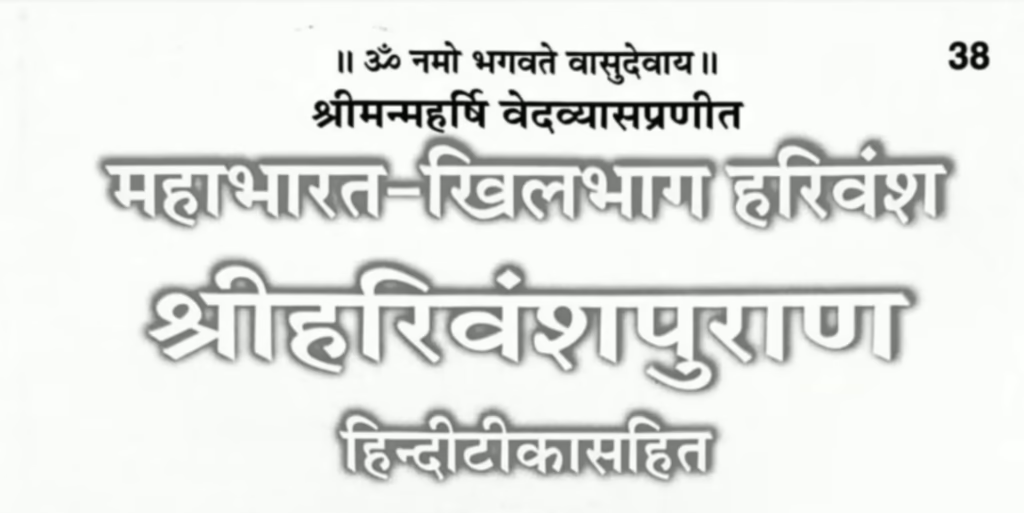
Brahminical tradition treats the Harivansha Purana not merely as another storybook, but as an appendix to the Mahabharata and often glorifies it as the “fifth Veda” (Pancham Veda, meaning it carries Vedic authority). The 11th-century scholar Al-Biruni, in his work on India, noted that the Harivansha formed part of the Mahabharata corpus. Therefore, this text carries immense scriptural authority. It does not exist as a fringe document; it sits at the centre of the Puranic worldview. When the faithful claim that Hindu scriptures serve as repositories of science and morality, they must reckon with texts like the Harivansha, which they revere as authentic and ancient. Read more: Bhavishya Purana: Puranic Chronology & Foreign Influence
The Authority Problem
People often meet any criticism of these texts with outrage – the standard accusation of hurting religious sentiments. A person can face vilification for wearing the wrong clothes to a temple, yet questioning the content of a “holy” book amounts to blasphemy. However, if we aim to take these scriptures seriously, we must examine their actual contents. Furthermore, the Harivansha Purana’s reputation as a Pancham Veda elevates it to Vedic rank, which should alarm anyone who has read the Vedas’ injunctions. If this text represents the pinnacle of divine revelation, we must ask: what kind of divinity are we dealing with?
Methodology: Open the Book, Read the Words
This analysis draws on a direct reading of the Harivansha Mahapurana published by Gita Press, Gorakhpur, with translation by Pandit Ramnarayan Dutt Shastri Pandey. Anyone can verify the verses and commentary because they remain publicly available. Consequently, the approach is simple: open the book, go chapter by chapter, and identify the narrative logic of creation, lineage, and sexual ethics. What emerges is a pattern of incest, promiscuity, and absurd cosmology that remains utterly incompatible with the scientific temper the same tradition now claims to embody.
Creation by Egg and Water: Science or Superstition?
The Cosmic Egg
The Harivansha begins with a creation story that would embarrass a kindergarten science class. First, Narayana created water. Then, in that water, a golden egg appeared and floated for a long time. From this egg, Brahma was born. He lived inside the egg for a year and then split it into two halves: one became the earth (Bhuloka) and the other the sky (also called Bhuloka?). In between, he placed the sky. Notably, the text claims the earth was made to float on water.[source]
“Tadantar Svayambhu bhagavan Narayan ne nana prakar ki praja utpann karne ki ichchha se sabse pehle jal ki srishti ki.” (Then the self-born Lord Narayana, desiring to create various creatures, first created water.)
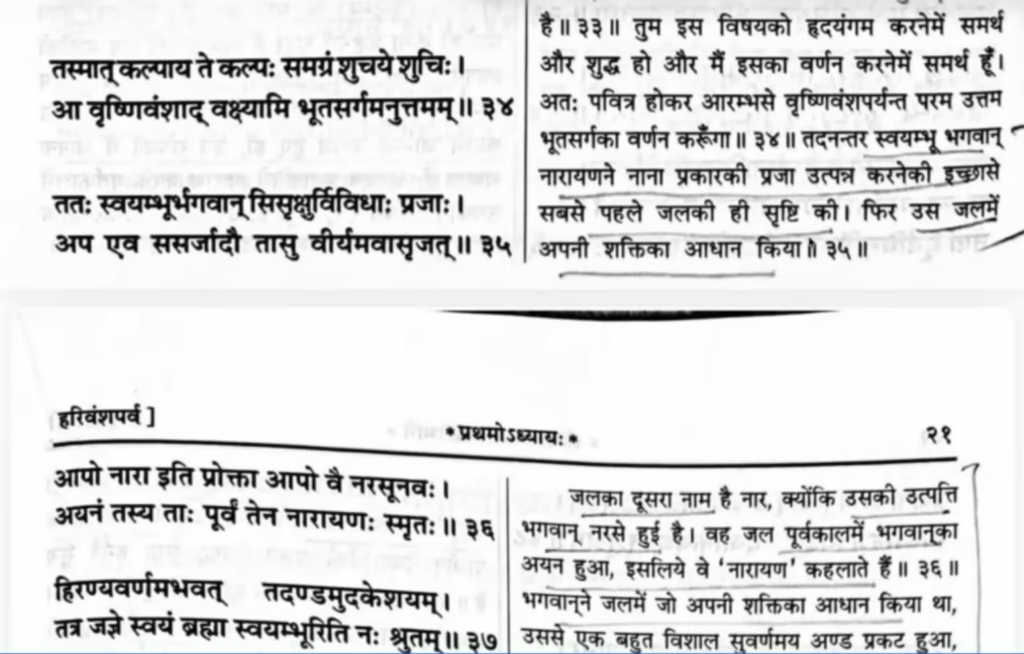
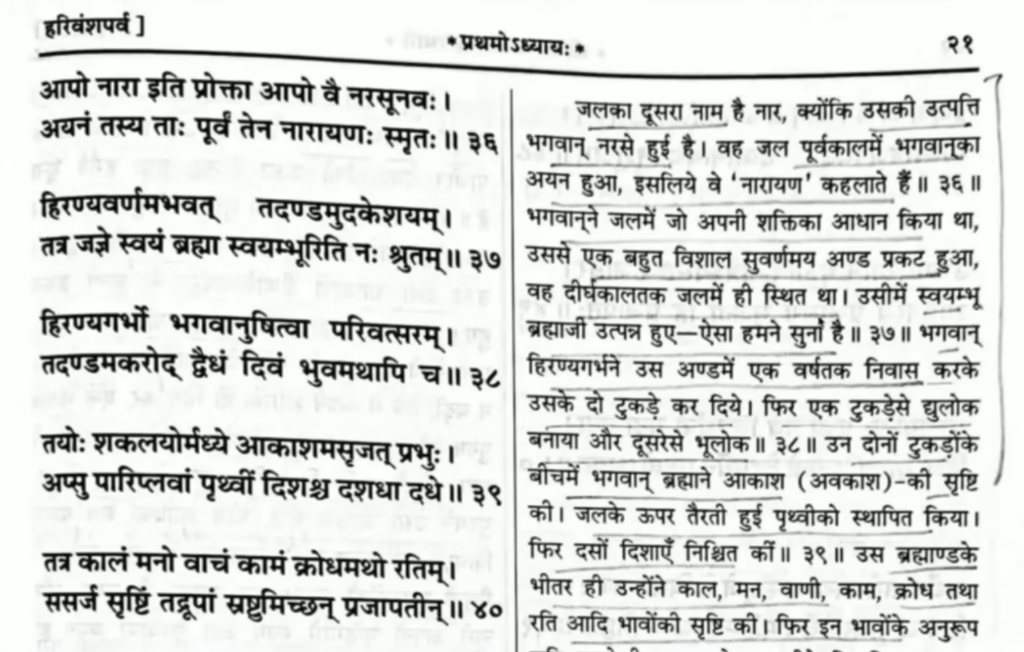
This clearly is not science. A civilization that honestly records its knowledge would not claim that the earth floats on water. Yet, the text presents this as revealed truth. Moreover, the Harivansha states that Brahma, after emerging from the egg, created seven mind-born sons (Manas Putras) — the Saptarishis. But here, the Harivansha already contradicts other Puranas: some texts say there were ten, not seven. The inconsistency remains glaring, yet no orthodox defender will address it. Instead, they pivot to metaphors and allegories, a luxury not afforded to their critics.
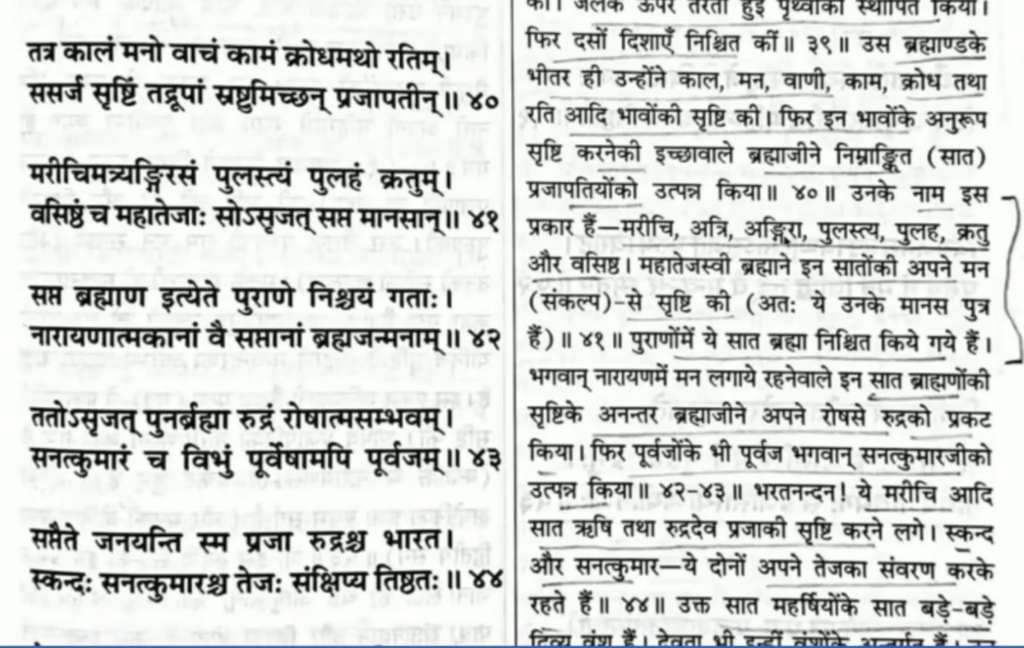
Mind-Born Misogyny
Brahma then creates further beings from different parts of his body — and here the casteist biology enters. The text explicitly states:
“Upasthay se manushya utpann kiye lekin jangha se asura ko utpann kar diye.” (From the generative organ he created humans, but from the thighs he created Asuras.)
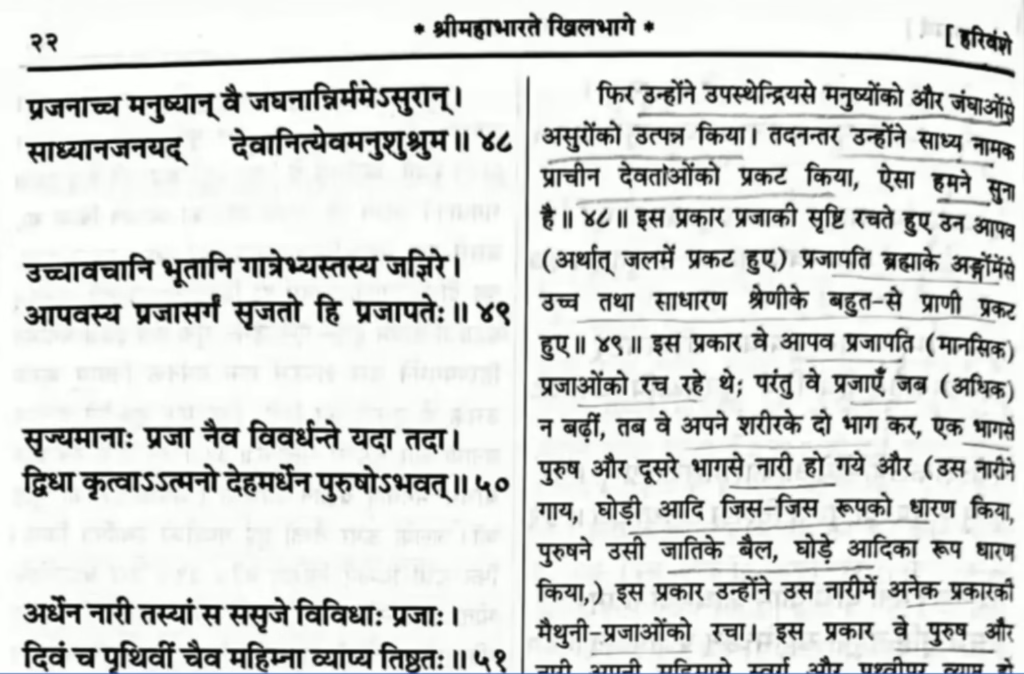
This verse directly assaults the Dalit-Adivasi narrative that Shudras were born from the feet. Here, Asuras (often coded as lower castes or non-Aryans) emerge from the thighs. The text is not subtle: your social place is biologically determined by divine fiat.
Why This Matters
These origin stories are not harmless myths; they form the foundation of a hierarchical social order. If Brahma intentionally creates some beings from his thighs and others from his genitals, the implication becomes clear: some are ritually impure by birth. The later Varna system merely institutionalizes this theology. Therefore, to defend these texts is to defend a worldview in which inequality is cosmic, not social.
The Incest of Manu and Shatarupa
Siblings and Spouses
The Harivansha’s second chapter dives into the lineage of Manu, the progenitor of humanity. The story is straightforward yet repulsive: Brahma splits his body into two halves – one becomes Manu, the other becomes Shatarupa. In plain terms, they are born from the same body, making them either siblings or parent-child. Then, the text states:
“Unhonne deh ke dusre bhag se bani ayonija Shatarupa ko patni rup mein sweekar kiya.” (He [Brahma] accepted Shatarupa, born from the other part of his body, as his wife.)
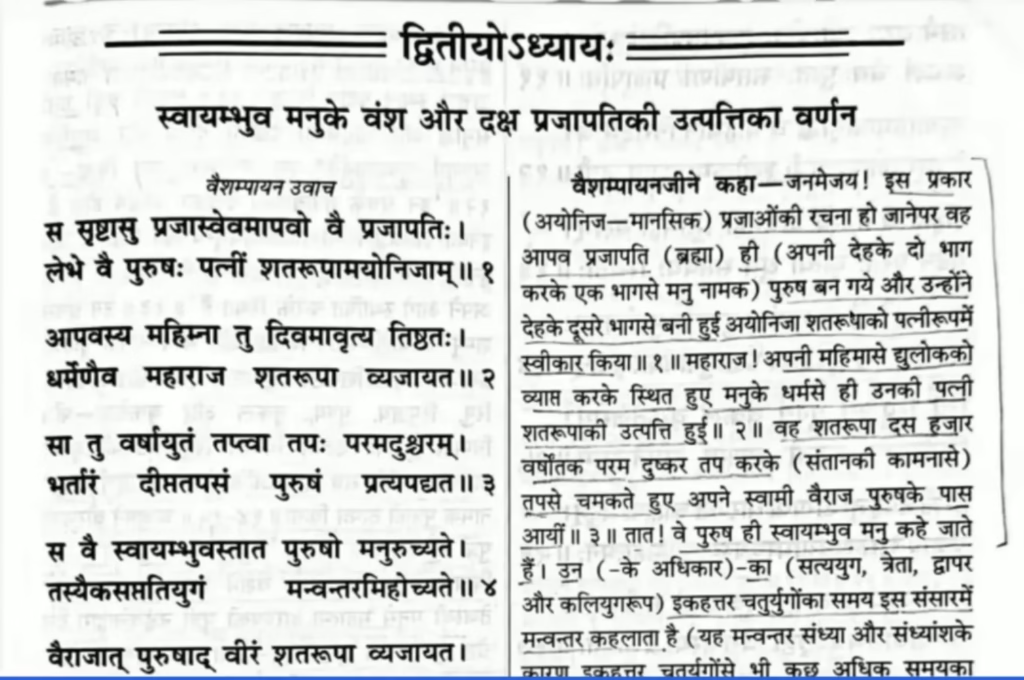
The text explicitly describes Shatarupa performing severe penance for 10,000 years desiring a son, and then approaching her husband — who is also her brother or father, depending on interpretation. The Gita Press translation tries to soften this by putting “from his own body” in brackets, but the original Sanskrit leaves no room: they come from the same body. In any modern legal framework, this constitutes incest. In the so-called divine scripture, it becomes the origin of humanity.
The Challenge to Shankaracharyas
This is not a metaphorical reading. The text describes a literal reproductive act between two beings who share a single bodily origin. If any modern religious leader — whether a Shankaracharya or a Puranic scholar — can clarify whether Shatarupa is Manu’s daughter, sister, or wife, they should do so publicly. The ambiguity alone is damaging: a revelation from God should not need a PR team to sanitize its family tree.
The Propaganda of Purity
While these verses describe incest as a holy act, the same Brahminical culture today polices inter-caste marriages and even the clothes women wear. The hypocrisy is staggering. The scriptures — on which this entire moral edifice rests — begin with a brother-sister/husband-wife union. Yet, a Dalit boy touching a Brahmin girl becomes a crime against “culture.” The double standard is not a bug; it is a feature of a system that uses selective morality to maintain dominance.
The Polyandry of Marisa and the Ten Brothers
The Deal with the Moon
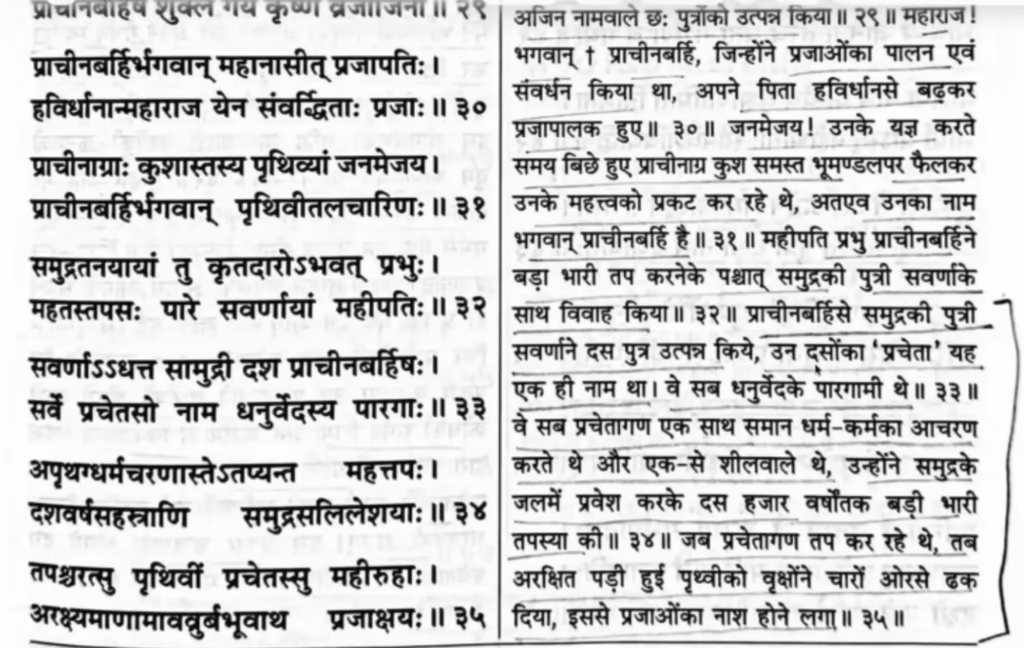
After the Prachetas (ten brothers) emerge from the line of Prithu, they engage in extreme penance underwater for 10,000 years. While they are away, trees overrun the earth, and when they return, they burn the forests in anger. The Moon god, Soma, intervenes and offers them a deal:
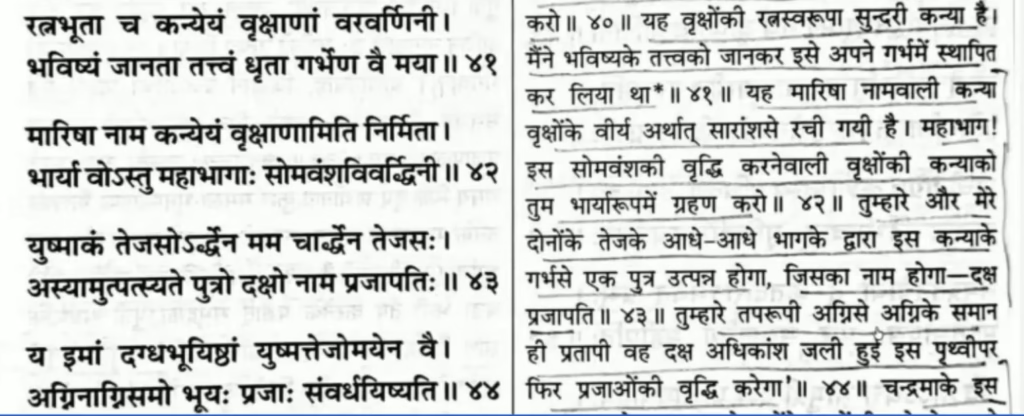
“Yeh vrikshon ki ratna swaroopa sundari kanya hai. Mainne bhavishya ke tatva ko jaan kar isse apne garbh mein sthapit kar liya tha.” (This beautiful maiden, the jewel of the trees, I had placed in my womb knowing the future.)
Soma had hidden a tree-girl, Marisa, and now he offers her to the ten brothers as a common wife to pacify their anger. The terms are explicit:
“Tumhare aur mere dono ke tej ke aadhe-aadhe bhaag ke dwaara is kanya ke garbh se ek putra utpann hoga.” (From half of your and my brilliance, a son will be born from this girl’s womb.)
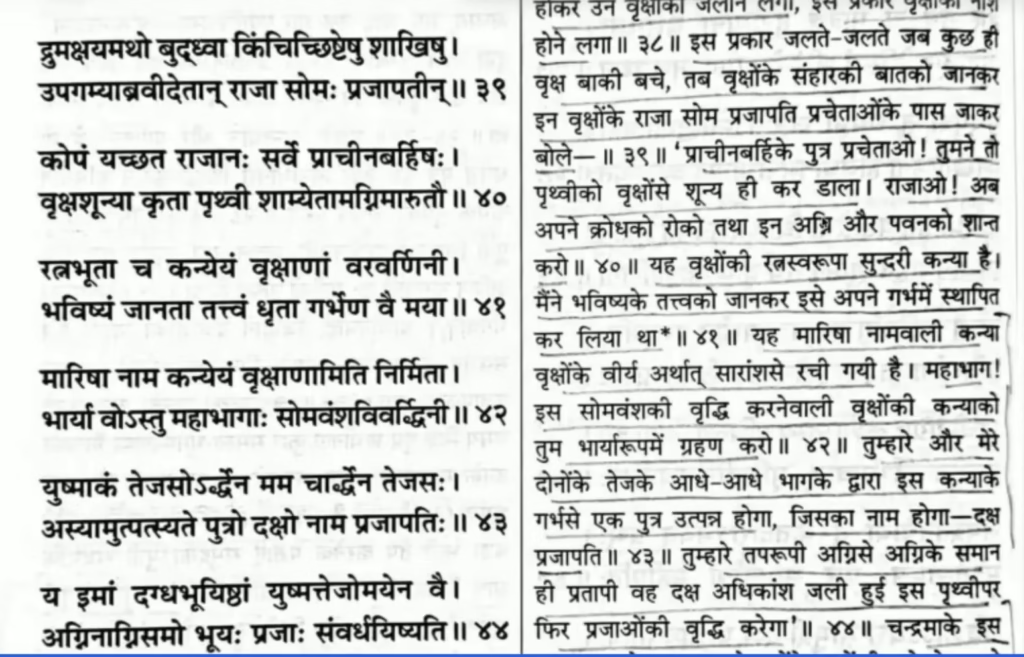
The Moon is not just giving away a woman; he is actively participating in her impregnation. The “half of my brilliance” implies the child will have the Moon’s seed, and the other half from the ten brothers. The text then says:
“Tadantar un prachetaon ne apne man se Marisa mein garbh sthapit kiya.” (Then the Prachetas, through their collective mind, established an embryo in Marisa.)
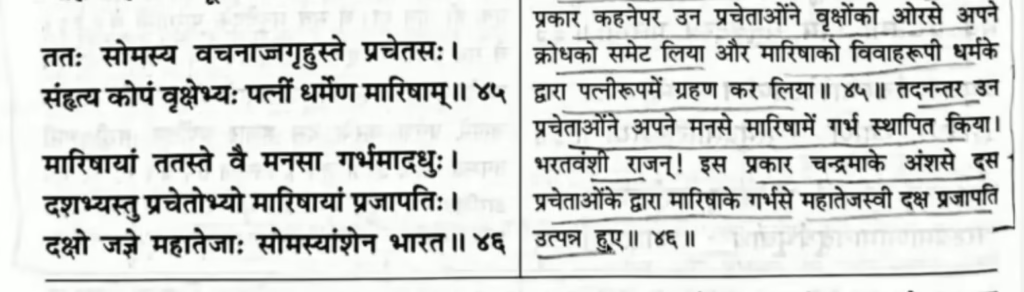
Ten brothers. One woman. A divine pimp. This is the “family values” of the Pancham Veda.
The Child Daksha
From this polyandrous union, Daksha is born — the same Daksha who will later become a central figure of Puranic lore. The text celebrates this birth as glorious, even though it involves essentially ten males and an extra-god insemination. There is no moral condemnation, no scriptural note that this is allegorical. It is presented as a matter-of-fact divine act. Can we really call this a moral guide?
Why It’s Still Defended
Apologists will call this a symbolic representation of natural elements. But the text is clear: Marisa is a woman, the Prachetas are men, and Daksha is their son. If this is symbolism, then the entire Puranic genealogies are symbolism, and the caste system derived from them collapses. You cannot cherry-pick literalism: if Ram Setu is literal, so is Marisa’s communal marriage.
The Time-Traveling Incest of Daksha and the Moon
The Paradox That Janmejaya Saw
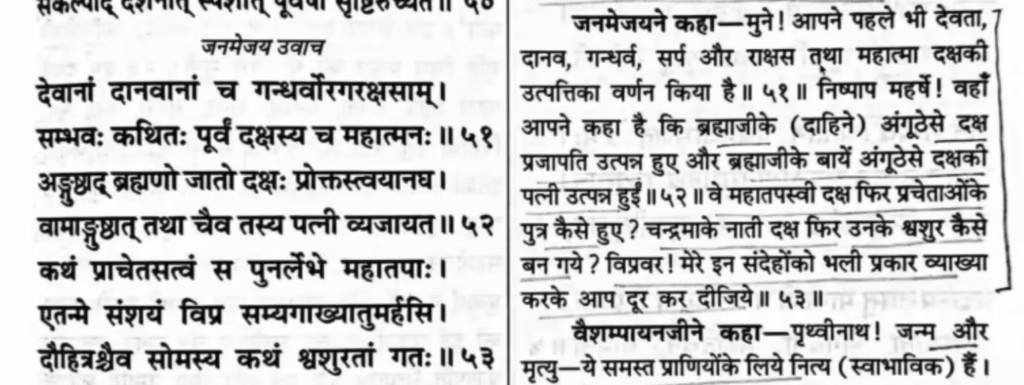
The Harivansha contains a remarkable passage where King Janmejaya, the listener of the Mahabharata, interrupts the narrator Vaishampayana to point out a logical and moral contradiction:
“Mune aapne to pehle hi bata diya hai ki Brahma ji ke dahine angoothe se Daksha paida huye the… aur aap yahan par to humko kuchh aur kahani batane lage. Aap bol rahe hain Chandrama ke naati to Daksha huye, ab phir unke sasur bhi aap bana diye.” (O sage, you had earlier said that Daksha was born from Brahma’s right thumb… but here you tell a different story. You say Daksha is the Moon’s grandson, and now you also make him the Moon’s father-in-law.)
In simple terms: in one version, Daksha is born from Brahma’s thumb. In another, he is the son of the Prachetas and Marisa (with Moon’s brilliance), making him the Moon’s grandson. Then, Daksha gives his daughters in marriage to the Moon, making him the Moon’s father-in-law. So the Moon is both Daksha’s grandfather and son-in-law — a time-loop incest that even ancient listeners found absurd.
The Sage’s Shocking Reply
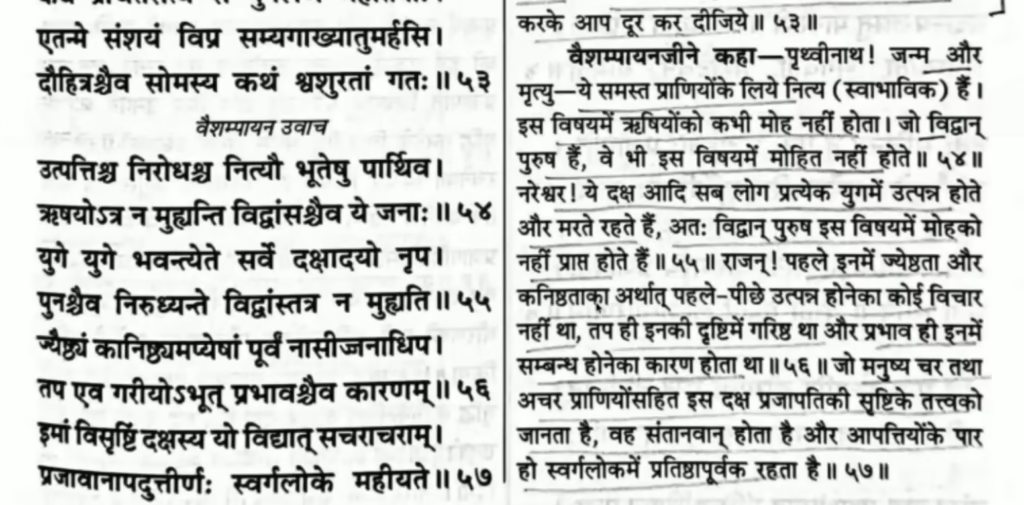
Vaishampayana’s answer is a classic example of religious gaslighting:
“Janma aur mrityu yah samast praniyon ke liye nitya hai. Is vishay mein rishiyon ko kabhi moh nahin hota… pahale inmein jyeshthata aur kanishthata ka koi vichar nahin tha.” (Birth and death are eternal for all beings. The rishis never get confused about this. Earlier, there was no concept of seniority or juniority among them.)
In other words: “Don’t worry about who came first or who is whose relative. The rishis didn’t care, so neither should you.” This is the scriptural defense of incestuous lineage: ignore the contradictions, focus on the tapas (penance). The text effectively says that the gods operated on a morality where incest was not a concept because there was no notion of chronological or familial hierarchy.
The Implication for Caste Purity
If the very gods engage in grandfather-granddaughter incest, what basis does the Brahminical order have to enforce endogamy and “purity” of lineage? The text’s own logic annihilates the very concept of pure bloodlines. Yet, the Dharmashastras punish inter-caste sexual relations with death or mutilation. This selective application of morality is the engine of caste oppression.
The Twisted Birth of Narada
Born to Whom?
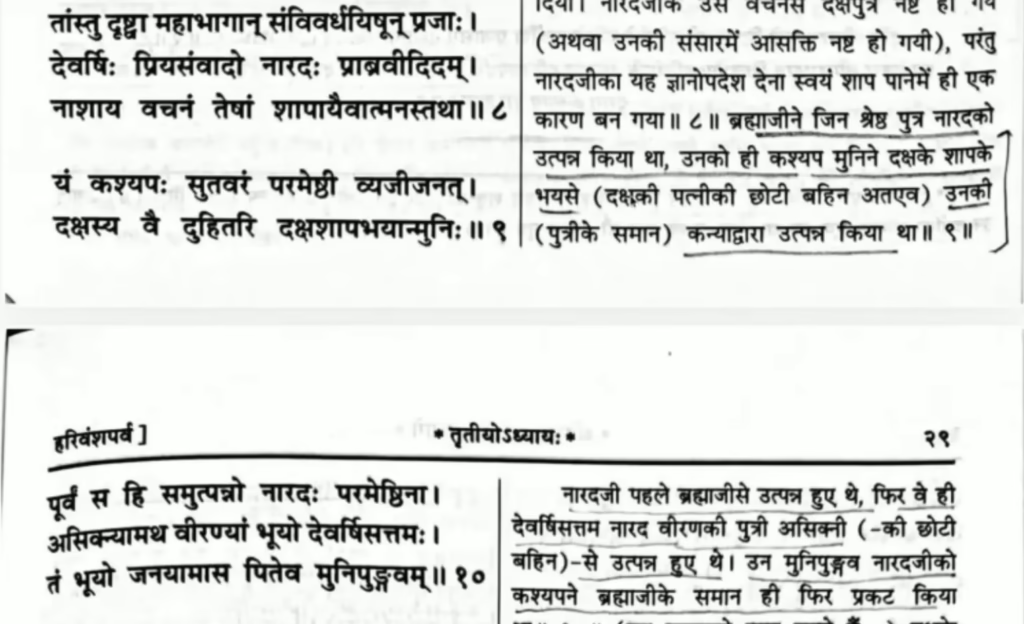
The Harivansha’s account of Narada’s birth is a labyrinth of incest and confusion. First, Narada is born from Brahma. Then:
“Unhonne hi Kashyap muni ke Daksha ke shraap ke bhay se unki kanya dwara utpann kiya tha.” (He [Brahma] again produced him [Narada] through the daughter of Daksha due to the fear of Daksha’s curse to Kashyapa.)
The Gita Press translation inserts a desperate bracket here: “[Arthaat chhoti saali]” (meaning younger sister-in-law), but the original text says “kanya” (daughter). The passage means: Brahma, fearing Daksha’s curse on Kashyapa, re-incarnates Narada through Daksha’s daughter. But Daksha is Brahma’s son. So Brahma’s son’s daughter — Brahma’s granddaughter — gives birth to Brahma’s son Narada. This is such a mess that the translator felt compelled to falsify the relation.[source]
The Curse and the Daughters
Daksha, enraged by Narada’s habit of turning his sons into ascetics (thus preventing them from producing progeny), curses Narada to be reborn. The solution? Narada will be born from Daksha’s daughter. But this daughter is not a daughter — “chhoti saali” is a desperate attempt to hide the fact that Daksha’s daughter is also Brahma’s daughter, creating a closed loop of divine incest.
Why Textual Integrity Matters
If a religious organization has to doctor translations to protect its sensibilities, it admits that the original is obscene. Millions of Hindus revere the Gita Press as the authentic voice of Sanatana Dharma. When their own translations balk at the content, it proves that the scriptures are uncivilized by any modern standard. The faithful are being fed a sanitized version of texts whose unvarnished content would horrify them.
The 60 Daughters Strategy: When Sons Wouldn’t Be Controlled
Narada the Buddhist Evangelist
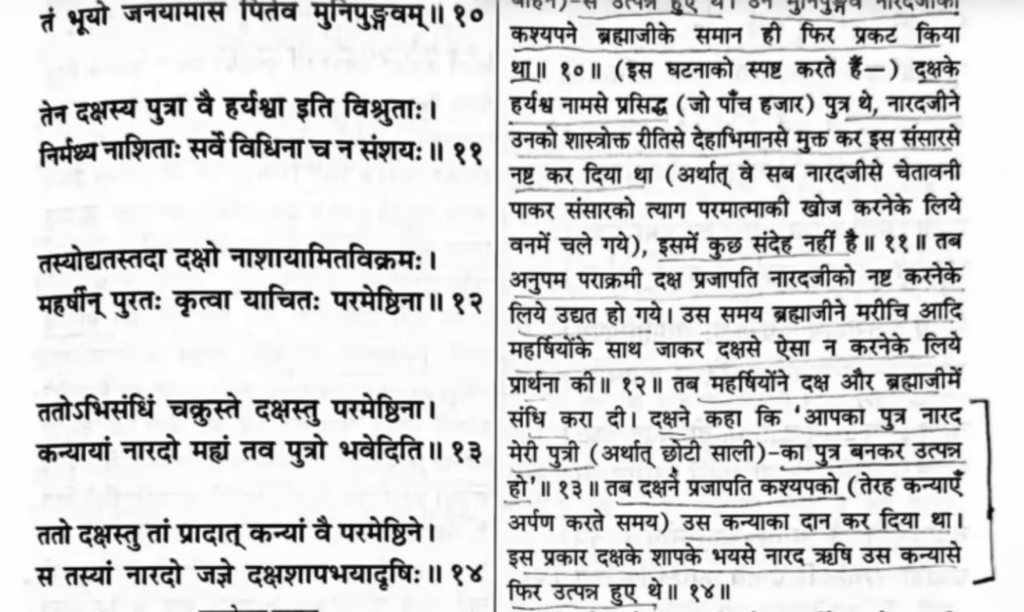
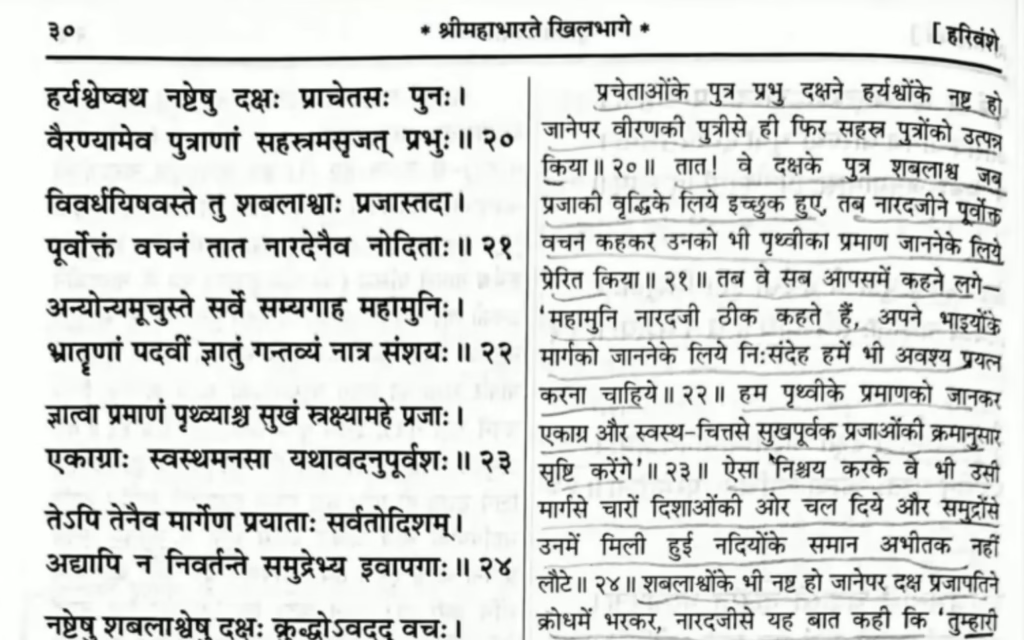
The Harivansha portrays Narada as a figure who persistently leads Daksha’s sons away from householder life into asceticism. The term used is “Jina-putra” (son of Jina), which historically refers to a Buddhist or Jain monk. The text says:
“Narad ji unko sashulka reeti se mukt karke sansar se nasht kar diya.” (Narada, using proper means, liberated them and destroyed them from the world.)
Daksha’s first 1,000 sons — then another 1,000 — are all “corrupted” by Narada and never return. Furious, Daksha decides to produce daughters instead, because:
“Kanyayen stri hone se Narad ji ke aatmgyan ke upadesh ki paatra nahin thi.” (Daughters, being women, were not qualified for Narada’s teachings of self-knowledge.)
The Misogyny of Control
This verse encapsulates the Brahminical approach to women: they are not entitled to spiritual knowledge, so they are useful only for reproduction. Daksha produces 60 daughters and distributes them among gods and sages — 13 to Kashyapa, 27 to the Moon, 10 to Dharma, and so on. This is literally human trafficking sanctioned by scripture. The daughters have no agency; they are currency to pacify male aggression and continue lineages.
The Anti-Buddhist Subtext
Many scholars identify the conflict between Daksha and Narada as a coded war between Brahmanism and Buddhism/Jainism. The term “Jina” was used for Buddha, and the Harivansha explicitly blames Narada for depleting the Brahminical workforce. By making Narada a “Jina-putra,” the text slanders Buddhist ideals as anti-natalist and destructive, while also reinforcing gender hierarchy: the solution to the Shramana threat is to keep women uneducated and brood-mare-like.
The Pattern of Promiscuity: Why Scripture Normalises It
From Cosmic Chaos to Social Order
All these stories — Manu-Shatarupa, Marisa-Prachetas, Daksha-Moon, Narada’s rebirth — share a common thread: incest and polyandry/polygyny are not aberrations but the very mechanism of creation. The divine realm is a free-for-all where the only rule is the production of progeny. Later Brahmanical law, however, imposed strict marriage rules on ordinary humans, particularly women and Shudras. This is a classic control mechanism: the elites (Brahmins and gods) are beyond morality, while the masses face intense policing.
The Contradiction That Breeds Hypocrisy
The same scriptures that describe gods sharing wives and marrying their own daughters are used to justify honor killings of inter-caste couples. This cognitive dissonance is sustained through selective reading and the ban on questioning. When the Harivansha says “there was no concept of seniority or juniority,” it provides a loophole for everything — but that loophole is only applied to defend the scriptures, never to liberate actual human relations.
The Political Function
Anti-caste scholars like Dr. B. R. Ambedkar and Periyar E. V. Ramasamy pointed out that such scriptures were written to create a racial and social hierarchy. The promiscuity of the top tier was normalised, while the bottom’s sexuality was criminalised. The Harivansha is not an innocent myth; it is a blueprint for Brahminical patriarchy dressed in cosmic garb.
Conclusion: Read the Scriptures to Break the Spell
The Trap of “Scientific” Hinduism
Today, Hindu apologists on YouTube and social media aggressively market the Vedas and Puranas as repositories of advanced science. The Harivansha’s golden egg and earth-on-water cosmology should be enough to debunk that. But beyond cosmology, the ethical universe of these texts is primitive, violent, and incestuous. A religion that claims to uphold the highest moral standards cannot simultaneously hold the Harivansha as the fifth Veda.
The Ambedkarite Imperative
Ambedkar wrote extensively on the need to destroy the authority of the Shastras. The Harivansha is a case study in why that destruction is necessary. It is not enough to “reinterpret” or “reform” — the entire text must be exposed for its anti-social content, and its authority must be revoked in public consciousness.
What Can You Do?
- Read the texts yourself. Get a copy of the Gita Press Harivansha and verify every verse cited here. The power to challenge lies in direct knowledge.
- Share this article. Use it in discussions with those who claim scriptures are flawless. Force them to account for specific verses.
- Demand public clarifications. Tag Shankaracharyas and other religious heads on social media, asking them to explain the relations in the Harivansha without evasion.
- Support anti-caste media. Platforms that critically examine scriptures without fear need resources to continue.
- Organize reading circles. In your community, start sessions where you read and discuss these texts openly, especially with Bahujan youth who have been kept away from them.
- Challenge the curriculum. If your child’s school teaches these stories as history, file a formal complaint citing the obscene content.
Frequently Asked Questions
What is the Harivansha Purana?
The Harivansha Purana is an ancient Hindu scripture considered an appendix to the Mahabharata. It is often exalted as the “fifth Veda” (Pancham Veda) and primarily narrates the lineage of Hari (Krishna), along with creation stories and genealogies. Read more: Bhagavatam Purana Critique: Science & Women
Does the Harivansha Purana contain instances of incest?
Yes, a direct reading reveals multiple accounts of incest, such as the union of Manu and Shatarupa (born from the same body) and the time-loop relationship where Daksha is both grandfather and son-in-law to the Moon.
Why is the Harivansha called the fifth Veda?
Traditional Brahminical teachings elevate it to Vedic status because it complements the Mahabharata and is considered essential for understanding dharma and lineage, thus granting it supreme scriptural authority. Read more: Mahabharata: History, Lineages, and the Truth of ‘Niyoga’
How does the Harivansha Purana relate to the caste system?
The text reinforces caste hierarchy through creation myths that assign different origins to beings (e.g., Asuras from thighs), which later jurisprudence uses to justify birth-based inequality and endogamy.
Is the Harivansha Purana still read today?
Yes, it is widely published by presses like Gita Press and is read as a sacred text in many Hindu circles. However, its controversial content is often sanitized or allegorized in public discourse.
Disclaimer
Key terms used in this article and their meanings in context:
- Harivansha: An appendix to the Mahabharata, elevated to the status of a Mahapurana and sometimes called the fifth Veda, narrating the lineage of Hari (Krishna).
- Manu: The progenitor of humanity in Puranic lore, born from Brahma’s body and paired with Shatarupa.
- Shatarupa: Born from the other half of Brahma’s body; married to Manu, her brother/father figure.
- Prachetas: Ten brothers, sons of Prachinabarhi, who collectively married Marisa.
- Daksha: A Prajapati (lord of creatures) born from the polyandrous union of Marisa and the Prachetas, later father of 60 daughters.
- Incest: Sexual relations between closely related individuals; repeatedly depicted in the scriptural accounts of divine births.
Do you disagree with this article? If you have strong evidence to back up your claims, we invite you to join our live debates every Sunday, Tuesday, and Thursday on YouTube. Let’s engage in a respectful, evidence-based discussion to uncover the truth. Watch the latest debate on this topic below and share your perspective!

Skeptical Indian is an independent researcher documenting
caste discrimination through primary sources, Hindu
scriptures, court records, and government data.
CasteFreeIndia.com has published 100+ evidence-based
analyses since 2024.