The Orchestration of Anti-Reservation Sentiment Following NEET PG Cut-Off Adjustments
A discernible pattern emerges within the societal discourse concerning reservations in India, often triggered by administrative adjustments to examination criteria. Recently, the focus has shifted to the National Eligibility cum Entrance Test for Postgraduate (NEET PG Cut-Off) examination, where modifications to the qualifying percentile have ignited a wave of public outcry, heavily skewed against the principle of reservation and, by extension, the marginalized communities it seeks to uplift. This phenomenon is not a spontaneous eruption of concern over academic standards; rather, it appears to be a calculated mobilization of a specific, caste-entrenched segment of society against the empowerment of Dalit and backward classes.
The controversy surrounding the lowering of cut-offs is being weaponized to disseminate falsehoods and sow seeds of contempt against those who benefit from affirmative action. The core issue being deliberately obscured is the reality of vacant seats in specialized medical postgraduate streams, an issue rooted in systemic preferences rather than the capability of reserved category candidates. Think of it like this: If a factory has 100 specialized machines sitting idle because the operating manual is too complicated, lowering the training requirement isn’t lowering quality; it’s ensuring the machines—vital for production—actually get used.
Table of Content:
- Understanding the NEET PG Examination Framework
- The Deceptive Media Blitz Against Reservation and the NEET PG Cut-Off Reservation Controversy
- Historical Precedents and Inconsistency in Outrage
- The Socio-Economic Dynamics of PG Stream Selection
- The Systemic Weaponization Against the Empowered Dalit-Bahujan
- The Philosophical Foundation of Casteist Reaction
- Conclusion: The True Intent Behind the Notification
Understanding the NEET PG Examination Framework
For clarity, the context must be established regarding the medical examination hierarchy in India. The NEET exam, in its undergraduate form, is the prerequisite for pursuing an MBBS degree, the basic medical qualification. Following the completion of the MBBS (Bachelor of Medicine, Bachelor of Surgery), aspiring doctors seek further specialization through postgraduate studies, akin to pursuing a Master’s degree after a Bachelor’s. This postgraduate specialization is accessed via the NEET PG exam. Thus, candidates taking the NEET PG are already qualified medical practitioners (MBBS doctors) seeking MD (Doctor of Medicine) or MS (Master of Surgery) degrees.
The Distinction Between Clinical and Non-Clinical Streams
Postgraduate medical education is broadly categorized into clinical and non-clinical branches. Clinical branches, such as General Medicine, General Surgery, Obstetrics and Gynecology, and Orthopedics, involve direct patient care, OPD consultations, and surgical procedures. These are typically the streams that yield higher income potential and are thus highly sought after by doctors immediately following their MBBS. Consequently, these seats are usually filled quickly by candidates securing higher scores.
The Plight of Non-Clinical Specializations
In contrast, non-clinical branches include disciplines like Anatomy, Physiology, Biochemistry, Pathology, and Pharmacology. These streams primarily involve research, laboratory work, and teaching within medical colleges, with minimal direct patient interaction. Medical professionals pursuing these specializations often aspire to become academicians or researchers. The crucial reality, as evidenced by reporting from sources like Tribune News Service, is that approximately 18,000 PG seats remain vacant nationally in these fields. This persistent vacancy is the fundamental driver behind the recent policy adjustments.
The Role of Faculty Shortages
The government and the National Medical Commission (NMC) have cited faculty shortages in medical colleges as a significant factor necessitating these adjustments. If non-clinical seats remain unfilled, the supply of future medical educators dwindles, further exacerbating the faculty crisis. The decision to lower cut-offs, therefore, is an administrative measure aimed at filling these essential, albeit less lucrative, teaching and research positions.
The Deceptive Media Blitz Against Reservation and the NEET PG Cut-Off Reservation Controversy
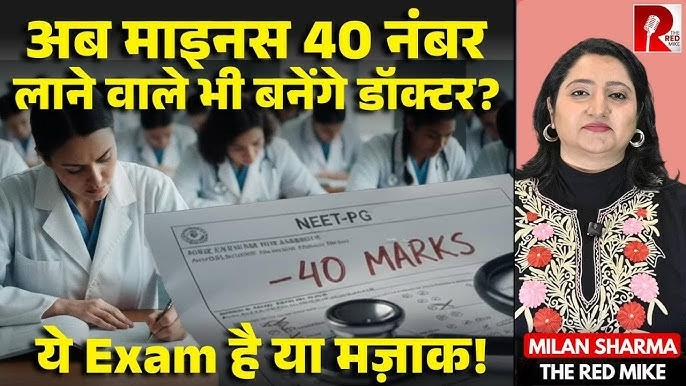
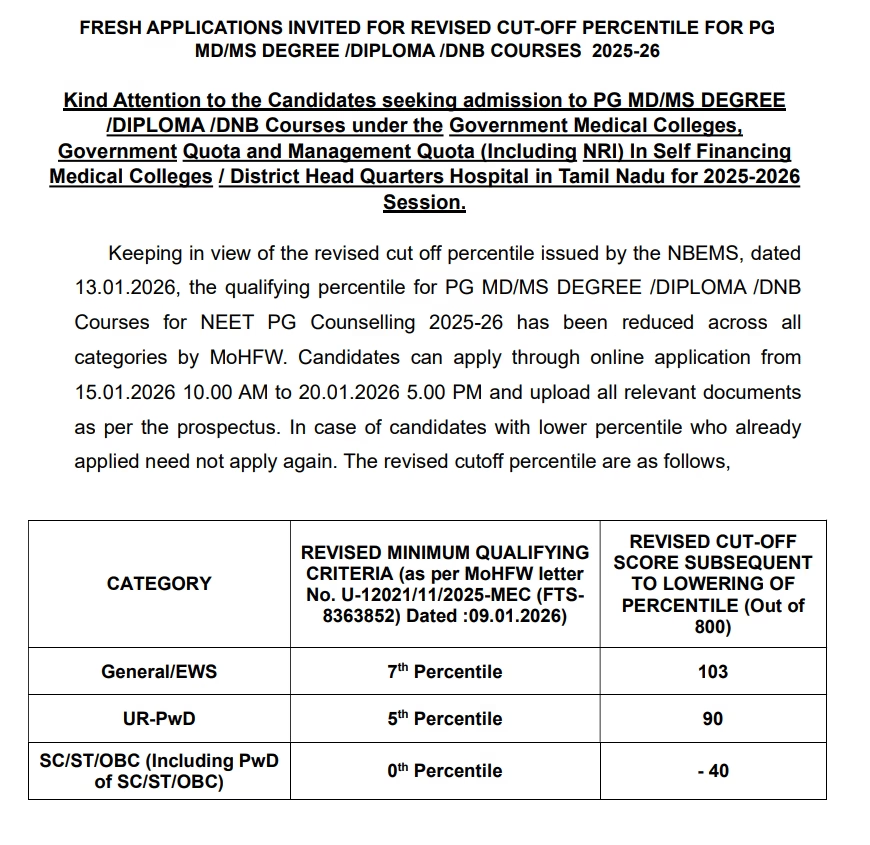
The announcement of revised cut-offs immediately triggered a manufactured crisis in specific sections of the media and on social media platforms. The narrative rapidly shifted from a discussion about seat fulfillment to an attack on the integrity of reserved categories. The adjustment involved lowering the qualifying percentile for the General/EWS categories to 7 percentile, while setting it at 0 percentile for Scheduled Castes (SC), Scheduled Tribes (ST), and Other Backward Classes (OBC). A 0 percentile score, given the negative marking in the exam, mathematically translates to approximately -40 marks.
Targeting Zero Percentile Over Seven Percentile
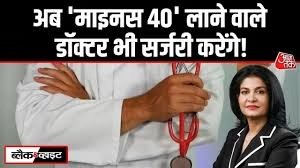
A review of headlines from various news outlets clearly demonstrates a calculated selectivity in reporting. Outlets often described as ‘pro-establishment’ or ‘godi media,’ alongside publications that claim neutrality but exhibit clear upper-caste biases—such as reports cited from RedFM/Red Mike by a figure named Milin Sharma, and coverage by News18 and Punjab Kesari—focused almost exclusively on the 0 percentile/ -40 mark threshold for SC/ST/OBC candidates. Headlines like, “-40 Number Laane Wale Bhi Banenge Doctor” (Even those scoring -40 will become Doctors) were pervasive. Significantly, the discussion did not equally scrutinize the 7 percentile cut-off for General Category candidates.

The Misrepresentation of ‘Becoming a Doctor’
The most egregious falsehood disseminated by these media houses was the claim that these candidates would “become doctors” based on these low scores. As established, candidates taking NEET PG are already MBBS doctors. The change pertains only to eligibility for postgraduate admission counseling.
This deliberate misstatement aims to propagate the idea that SC/ST/OBC individuals are gaining basic medical qualifications through undeserved means, severely damaging the established reputation of already practicing doctors from these communities. Isn’t it astonishing how easily complex qualification processes can be flattened into misleading soundbites designed purely for outrage?
The ‘Merit’ Fallacy Propagated by Media
News outlets like TV9 reportedly questioned the very integrity of medical education, suggesting that “merit has ended” in medical education. This framing ignores the fundamental reason for the cut-off reduction: the systemic non-uptake of non-clinical seats. When candidates are already MBBS holders, the implication that they are acquiring a foundational professional license without merit is patently false and designed solely to foster contempt. The consistent focus on the 0 percentile, while ignoring the fact that these candidates have already cleared the high-stakes NEET UG exam and completed MBBS, reveals a deep-seated prejudice.
Historical Precedents and Inconsistency in Outrage
The current outcry is further exposed as inconsistent when examined against past governmental decisions. The concept of reducing cut-offs, even to zero percentile, is not novel for filling vacant PG seats. This reveals that the current manufactured outrage is politically and caste-motivated rather than being a sudden defense of merit.
Zero Percentile in 2023: Silence from the Critics
Reporting cited from The Hindu confirms that the qualifying cut-off for NEET PG was reduced to 0 percentile for all categories—General, SC, ST, and OBC—in 2023 when seats remained unfilled. Crucially, at that time, the backlash witnessed currently was conspicuously absent. The same media groups and commentators who are now decrying the 0 percentile for reserved categories remained silent when the same concession was applied universally. This disparity suggests that the alarm is only raised when the reduction explicitly or implicitly highlights a benefit accrual for reserved categories, even if that benefit is shared or stems from a prior universal concession.
Fluctuations in Past Years
Evidence from reports, including those by Aaj Tak referencing past years, indicates that cut-offs frequently drop significantly below the initially mandated levels. In 2024, the cut-off for General Category dropped to 5 percentile, and in 2022, it fell to 15 percentile, again for all categories when seats remained vacant. The established pattern confirms that NEET PG seats, especially in non-clinical fields, often remain unfilled, forcing administrative concessions across the board.
The Real Reason for the Current Notification
The difference this year lies in the specific notification format. By explicitly notifying a 7 percentile for General/EWS and 0 percentile for SC/ST/OBC, the government, intentionally or not, provided a clear, actionable data point for casteist elements to latch onto. This format allowed the narrative to be narrowly focused on the perceived injustice toward the General category, ignoring the universal historical context that zero percentile has been applied before to everyone.
The Socio-Economic Dynamics of PG Stream Selection
To truly comprehend why 18,000 seats remain empty, one must understand the economic incentives driving postgraduate choices among Indian medical graduates.
The Pursuit of Financial Success
The primary motivation for most doctors pursuing postgraduate education after MBBS is the enhancement of earning capacity. Clinical specialties offer direct avenues for private practice, consultations, and surgical income, leading to significant financial prosperity. Therefore, candidates with higher scores naturally gravitate towards these high-demand clinical posts.
The Disinterest in Academics and Research
Conversely, non-clinical streams, while vital for the foundational structure of medical science and education, do not offer the same immediate financial returns. A doctor specializing in, for example, Anatomy or Physiology, often spends their career in teaching or laboratory research, roles that traditionally command lower remuneration compared to specialized clinical practice in India. The common sentiment, as reflected in the observed behavior, is: why invest additional years and resources into a postgraduate degree (PG) only to become a professor earning a modest salary, when one can start earning significantly by practicing general medicine immediately after MBBS?
Anatomy: The people who teach future surgeons.
Microbiology: The people who identify new virus strains.
Biochemistry: The people developing your medicines.
These are the seats that are empty, and these are the seats these “0 percentile” candidates will fill.
The Appeal of Clinical Branches
The favored clinical branches—General Medicine, General Surgery, Pediatrics, OB/GYN, and Dermatology—are instantly desirable because they allow the doctor to maximize income potential immediately post-specialization. This economic rationale ensures that the clinical seats are quickly saturated by the top scorers, leaving the teaching-focused, non-clinical seats perpetually empty.
The Systemic Weaponization Against the Empowered Dalit-Bahujan
The current media frenzy serves a clear ideological purpose: to disrupt the growing social mobility and professional recognition of individuals from historically oppressed communities.
Erosion of Hard-Earned Reputation
A significant shift has been noted in recent years: individuals from SC/ST/OBC backgrounds are not only successfully completing MBBS but are also establishing themselves as reputable, sought-after practitioners. Where once caste prejudice might have deterred patients, this dynamic is changing as quality of care takes precedence. This increasing professional acceptance and social standing are perceived as a threat by the entrenched caste structure.
Manufacturing Narratives of Incompetence
The media campaign, focused solely on the ‘-40 marks’ or ‘0 percentile’ for reserved candidates, aims to delegitimize the qualifications of these established doctors in the public eye. The message forcefully conveyed is that SC/ST/OBC doctors only attain their positions through massive concessions, implying inherent unsuitability. This leads to dangerous public perceptions, where an individual might doubt the competence of a doctor simply based on their perceived background, reinforced by sensationalized headlines.
The Silence on General Category Concessions
The fact that the General category cut-off was also dropped to 7 percentile, and that all categories previously saw drops to 0 and 5 percentile, is systematically ignored. This selectivity underscores that the attack is not on the concept of cut-off reduction itself—which is necessary due to vacant seats—but on using the mechanism to malign the reserved groups. The argument is not about fairness but about maintaining hierarchical superiority by linking lower scores exclusively to the marginalized.
The Philosophical Foundation of Casteist Reaction
This predictable backlash echoes historical sentiments that fear any shift in power dynamics, especially those driven by education and professional achievement. This aligns with the observations that the dominant caste group, often self-proclaimed as the ‘world guru,’ reacts violently when marginalized groups achieve parity or recognition.
Echoes of Historical Prejudices
This pattern is consistent with historical attempts to discredit achievements through fabricated exceptions. Just as false stories might circulate about a teacher from a marginalized background being appointed with minimal marks in Rajasthan, the narrative around the NEET PG cut-off functions similarly: to create a generalized belief that all beneficiaries of reservation are incompetent.
The Role of Non-Mainstream, ‘Neutral’ Media
The participation of media entities that pride themselves on neutrality, such as the aforementioned Red Mike platform, is particularly telling. When issues concerning caste and reservation arise, these outlets shed their claimed objectivity, revealing the underlying caste bias that dictates their editorial stance. This suggests a unified front among various media ecosystems to reinforce caste hierarchies whenever opportunities arise.
Conclusion: The True Intent Behind the Notification
The adjustment of NEET PG cut-offs is an administrative response to a persistent structural problem: the massive vacancy in crucial non-clinical medical teaching positions, a problem rooted in socioeconomic disincentives for doctors to pursue teaching careers. However, the notification, by explicitly differentiating the new percentile thresholds, has been seized upon by casteist elements.
The resulting media storm is not an inquiry into medical education efficiency but a coordinated effort to spread misinformation. The core lie being propagated is that MBBS doctors from SC/ST/OBC categories are newly ‘becoming doctors’ based on -40 marks, effectively discrediting their existing professional status. This is compounded by the selective outrage that ignores previous universal zero percentile concessions.
What you can do?
Combating this manufactured outrage requires active dissemination of facts. First, understand the context: candidates are already MBBS doctors; the concession is for PG admission to vacant, non-clinical seats. Second, reject biased reporting by verifying information from primary sources, noting that previous concessions applied to all categories, including General, without similar protests. Third, actively counter the ‘doctor’ myth by clarifying that these scores relate to PG entrance eligibility, not foundational medical qualification. By refusing to internalize the false narrative that achievement from marginalized communities is solely based on lowered standards, one can resist the systematic attempts to undermine social justice measures.
Read more about Truth About IIT IIM Dropout Rates: Beyond Headlines
Find out more about Casteism & Corruption: Weakening India’s Judiciary
Do you disagree with this article? If you have strong evidence to back up your claims, we invite you to join our live debates every Sunday, Tuesday, and Thursday on YouTube. Let’s engage in a respectful, evidence-based discussion to uncover the truth. Watch the latest debate on this topic below and share your perspective!

Skeptical Indian is an independent researcher documenting
caste discrimination through primary sources, Hindu
scriptures, court records, and government data.
CasteFreeIndia.com has published 100+ evidence-based
analyses since 2024.