The Mahad Satyagraha ( Chavdar Pond Revolution): A Fight for Dignity and Water
The history of India is replete with various revolutions that have reshaped its destiny. From the French Revolution to the American Revolution, we have heard of numerous such movements. However, a pivotal movement that took place in India, known as the Mahad Satyagraha, often called the Chavdar Pond Revolution, is frequently omitted from mainstream historical narratives, yet it fundamentally altered the course of the nation. This was a revolution that directly challenged a deeply entrenched system where a significant portion of India’s population was systematically denied the basic human right to water.
Table of Contents:
Imagine a scenario where public spaces, even those accessible to stray animals and diseased creatures, were forbidden to the indigenous people of India, the true descendants of this land. This denial was not merely about access; it was religiously sanctified, woven into the fabric of a discriminatory religious code known as Brahmin dharma. The successful dismantling of this water barrier through the Mahad Satyagraha movement struck a significant blow to the very foundation of this oppressive religious structure. Therefore, understanding this revolution is crucial for comprehending India’s past and present struggle against casteism.
Importance of this Mahad Satyagrah
This movement is vital because many contemporary Indians, especially the youth, are unaware of this historical struggle for dignity. Uninformed about these historical realities, they might dismiss the existence of untouchability in the past, believing their ancestors were not complicit in these atrocities. The lack of comprehensive historical education in schools and colleges, coupled with the active suppression of information on some social media platforms, leaves many in a state of perpetual confusion. Misinformation, continuously fed to them, actively perpetuates this dangerous ignorance about caste realities.
Read more: History of Caste and Surname in India: A Comprehensive Guide
As a platform committed to evidence-based discourse, we aim to bring these facts to light with thorough research and authentic sources. This post delves into the historical background of the Mahad Satyagraha (Chavdar Pond Revolution) to illuminate the deep origins and lasting impact of untouchability in India.
The Mahad Satyagraha: A Defining Moment in Water Justice
Understanding the Context
The Mahad Satyagraha, also known as the Chavdar Pond Revolution, was a pivotal movement spearheaded by Babasaheb Dr. B.R. Ambedkar. Occurring on March 20, 1927, this historic event directly challenged the deeply ingrained practice of untouchability, specifically the denial of access to public water sources to Dalits. The movement gained immense momentum and is often called the ‘Great March’ or ‘Great Satyagraha’ due to the significant participation of Mahars, a community that constituted the largest Dalit group at the time. While the majority of participants were from Dalit communities, a few courageous individuals from so-called upper castes also joined Babasaheb in solidarity against injustice.[source]
Challenging the Narrative of Purity
This revolution was a direct confrontation against the deceptive narrative that untouchability was a foreign import, a concept alien to India’s ancient traditions and scriptures. Many falsely claimed that India’s sages and its so-called ‘Brahmin dharma’ were inherently free from such discriminatory practices. The Mahad Satyagraha aimed to expose the profound fallacy of these claims, demonstrating the deeply rooted nature of untouchability within the socio-religious framework of the subcontinent. The success of this movement was seen as a significant breach in the imposing edifice of the religion that enforced such brutal discrimination.
Historical Timeline and Immediate Connections
The Mahad Satyagraha in March 1927 was part of a broader series of escalating events in Babasaheb Ambedkar’s life and the burgeoning Dalit rights movement. Just a few months later, in December of the same year, Babasaheb famously led the historic burning of the Manusmriti, a foundational text of Hindu law that codified caste-based discrimination for centuries. Earlier in 1927, Babasaheb had visited the Bhima Koregaon memorial on ‘Shaurya Diwas’ (Valor Day), an event that commemorates the victory of Dalit soldiers in the British Army against the oppressive Brahmin Peshwas. This visit undeniably fueled his resolve and provided further inspiration for the struggles that followed, including the pivotal Mahad Satyagraha.
The Deep Roots of Untouchability: A Historical Investigation
Questioning the Origins of Water Deprivation
The prevalent denial of basic rights, such as access to water, was clearly not a recent phenomenon in Indian history. The question immediately arises: when and how did this practice become so deeply entrenched in Indian society? Historical records suggest that during the reigns of emperors like Ashoka and Harshavardhana, and even during the Pal dynasty, such extreme forms of discrimination might not have been as universally prevalent or religiously codified as they became later. Think of it this way: the vast time gap between Ashoka and Harshavardhana[source], spanning over a thousand years, suggests a gradual or perhaps a later introduction and hardening of these discriminatory practices into religious law.
The Role of Lost Knowledge and Institutions
Crucially, much of the indigenous knowledge and history of India, particularly that originating from ancient learning centers like universities such as Nalanda and Vikramshila, which were established by and for the native populace, has been systematically destroyed. This calculated destruction has created a massive void in our understanding of pre-Brahminical societal structures. Consequently, reliable information about the social fabric of ancient and medieval India often relies heavily on external sources, particularly the detailed accounts of foreign travelers who visited the subcontinent during those distant eras.
Insights from Ancient Travelers on Social Hierarchy
These travelers, arriving from various cultural backgrounds and holding diverse perspectives, meticulously documented their observations of Indian society. Their writings provide invaluable, firsthand glimpses into social hierarchies, customs, and prevailing beliefs concerning purity and pollution. By examining their accounts, particularly those of travelers who documented the lives of those considered ‘untouchables’ or ‘chandalas’ by later societal structures, we can begin to reconstruct the history of how untouchability was officially introduced and aggressively propagated throughout the land.
Megasthenes: An Early Glimpse into Indian Society
The Seven Classes of Society Described
Around 300 BCE, during the reign of Chandragupta Maurya, the Greek ambassador Megasthenes visited India. In his seminal work, ‘Indica’, he described Indian society as being divided into seven distinct classes. These classes were fundamentally based on occupation and lifestyle, not on a rigid, religiously mandated hereditary caste system as it evolved and crystallized much later. One of these classes, the third in his enumeration, comprised shepherds and nomadic herdsmen, demonstrating an occupational, not ritualistic, division..[source]
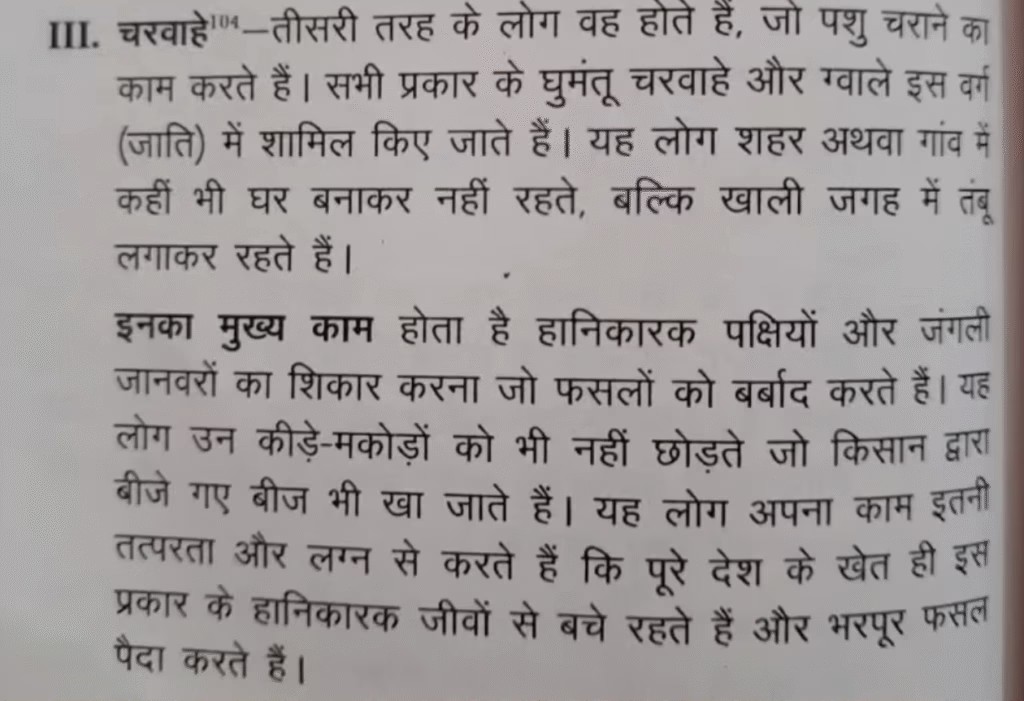
Evidence from early Greek chroniclers suggests that rigid, religiously enforced caste segregation based on birth, which fueled atrocities like water denial, was not the default structure of ancient Indian society. (Megasthenes, Indica)
Contrasting Early Accounts with Later Strictures
Megasthenes’ description notably lacks the detailed stratification and the concept of ‘untouchability’ based on pollution that became central to later Hindu legal texts. His system appears functional and occupational. This contrast highlights a critical historical shift: the solidification of caste as an inescapable birthright, directly impacting access to public resources like wells and ponds, appears to be a later development, potentially accelerated by the very texts the Mahad Satyagraha sought to challenge. The movement’s success forced a temporary reckoning with this imposed rigidity.
The Religious Enforcement of Exclusion
The Sanctity of Exclusion
The resistance faced by Ambedkar and his followers in Mahad was severe because the denial of water access was explicitly backed by religious sanctions derived from texts like the Manusmriti. These sanctions declared that drawing water from a public source used by ‘savarnas’ (dominant castes) would render the water polluted and the user ritually impure. This meant the exclusion was presented not as mere social prejudice, but as a divine mandate protecting ritual purity.
Challenging Purity Narratives
Dr. Ambedkar argued forcefully that if the water was rendered impure by the touch of a Dalit, then the entire concept of purity—which could be washed away by simple bathing or changing clothes—was inherently fragile and man-made, not divine. The powerful metaphor used was that if touching a Dalit contaminates water, the very foundation of caste purity is weak and unsustainable. This intellectual assault, coupled with mass direct action during the Chavdar Pond Revolution, was far more potent than simple appeals for charity.
The Legacy of the Chavdar Pond Revolution
The Mahad Satyagraha was a turning point. Although the initial resolution allowing Dalits to use public water tanks faced legal challenges and eventual retraction by authorities influenced by upper-caste pressure, the psychological victory was immense. It fundamentally awakened the Dalit community to the power of organized, assertive resistance against Brahmanical hegemony. The movement solidified Ambedkar’s leadership and provided a template for future dignity struggles across India.
Read more: Casteism in India: An Unflinching Contemporary Examination
The battle for water justice continues today, manifesting in struggles against manual scavenging and the appropriation of natural resources by dominant groups. The memory of the Chavdar Pond Revolution serves as a potent reminder that constitutional rights require continuous, evidence-based defense against entrenched social inertia and religious justifications for inequality. Caste-based discrimination, rooted deeply in history, demands proactive anti-caste action in the present.
Read more: Yes, Caste was asked: But Why, When, Where and Who asked?

Megasthenes’ Indica is one of the earliest written accounts of ancient India by a foreign observer. Written by the Greek ambassador Megasthenes, who lived at the court of Chandragupta Maurya (around 300 BCE), the book describes Indian society, governance, geography, and daily life during the Mauryan period.
Although the original text is lost, its fragments survive through later Greek and Roman writers. Indica offers fascinating insights into how India was seen from the outside—covering topics like social structure, administration, cities like Pataliputra, and even early observations that resemble caste divisions.
Why should you read it?
Because it gives you a rare, outsider perspective on ancient India—uncensored by later narratives. It helps you:
Understand how Indian society was structured over 2000 years ago
See early references to social divisions and hierarchy
Compare ancient observations with modern realities
Build a deeper, more evidence-based view of Indian history
What Can You Do?
- Educate Yourself: Deepen your understanding of Babasaheb Ambedkar’s life and the significance of the Mahad Satyagraha beyond superficial summaries.
- Amplify Verified Voices: Actively share evidence-based historical analyses, like this one, to counter prevailing misinformation regarding caste origins.
- Support Water Justice Movements: Engage with contemporary organizations fighting for equitable access to natural resources for marginalized communities.
- Challenge Caste Apologists: When narratives emerge claiming caste is ancient and immutable, cite historical actions like the Mahad Satyagraha as proof of active resistance and historical evolution.
Do you disagree with this article? If you have strong evidence to back up your claims, we invite you to join our live debates every Sunday, Tuesday, and Thursday on YouTube. Let’s engage in a respectful, evidence-based discussion to uncover the truth. Watch the latest debate on this topic below and share your perspective!