What UPSC Interview Bias Actually Proves — Manipulating Numbers Against SC/ST/OBC
The Union Public Service Commission (UPSC), the gateway to prestigious civil services in India, is facing serious allegations of systemic caste discrimination, particularly within its interview process. This investigation specifically targets UPSC Caste Bias interview practices, examining claims that Scheduled Castes (SC), Scheduled Tribes (ST), and Other Backward Classes (OBC) candidates are deliberately awarded lower marks in interviews to ensure that candidates from upper castes secure top administrative positions like IAS and IPS. We will delve into the evidence and the structural flaws that perpetuate caste bias in the UPSC examination system.
Read more: UP Govt Bans Caste Rallies: Implications for Social Justice
The UPSC’s Three-Tier Examination System
The UPSC civil services examination is a rigorous, three-tiered process designed to select the nation’s top administrators. It comprises:
- Preliminary Examination: This initial stage consists of objective-type questions, where candidates mark their answers on an Optical Mark Recognition (OMR) sheet. This process is automated, with computers scanning the sheets to evaluate answers.
- Main Examination: This stage involves descriptive, written essays and answers. Unlike the preliminary exam, the main examination papers are evaluated by human examiners. This is where, according to the allegations, the potential for bias begins to creep in.
- Interview (Personality Test): The final stage is the interview, officially termed a ‘Personality Test.’ This is the most controversial stage, with claims that it is here that deliberate discrimination based on caste occurs, significantly impacting a candidate’s final rank.
Allegations of Caste Discrimination in Interviews
The core of the allegations centers on the interview stage. It is claimed that interview boards, often composed of members from upper castes, discriminate against SC (Scheduled Caste), ST (Scheduled Tribe), and OBC (Other Backward Classes) candidates. Driven by their inherent biases, these members allegedly award fewer marks to candidates from marginalized communities, thereby reducing their chances of securing high-ranking posts and effectively favoring upper-caste candidates for the coveted positions.
Social media platforms have seen widespread discussion, memes, and the sharing of comparative data. The narrative often presented is that SC, ST, and OBC candidates, despite performing exceptionally well in the written Mains examination and securing high marks, see a significant drop in their scores during the interview. Conversely, upper-caste candidates with lower written scores often receive substantially higher marks in the interview, propelling them ahead in the final merit list.
Case Studies: Apala Mishra vs. Riya Dabi
To substantiate these claims, specific examples are frequently cited. Two prominent cases that have gained traction are those of Apala Mishra and Riya Dabi, illustrating potential UPSC caste bias interview outcomes.
Apala Mishra, reportedly from an upper-caste background, secured the 9th rank. Her marks in the written Mains examination were 816. However, she received a remarkable 215 marks in the interview. Her total score stood at 1031.
Riya Dabi, identified as a Dalit candidate, achieved the 15th rank. She scored 859 marks in the written Mains examination, significantly higher than Apala Mishra’s written score. However, her interview score was reportedly only 162. Her total score was 1021.

The discrepancy in interview marks, despite Riya Dabi’s superior performance in the written exam, is presented as stark evidence of caste bias. Critics question how such arbitrary-seeming scores (215 vs. 162) are awarded, especially when there is no fixed pattern of marks awarded per question answered correctly. The absence of a transparent, quantifiable system for awarding interview marks is seen as a breeding ground for discrimination.
The Flawed Interview and Personality Test System
The UPSC interview is officially termed a ‘Personality Test.’ This designation itself is a point of contention. To understand the issue, consider this: Are we judging administrative aptitude like a math test, or are we judging artistic appreciation? Unlike a typical interview where specific questions might have correct or incorrect answers, a personality test relies on subjective assessments. The interview panel, typically comprising five members including a chairman, engages in discussions and asks questions that are meant to gauge a candidate’s suitability for administrative roles.
The process is not structured around awarding marks for specific answers. Instead, the panel members collectively assign marks within a broad range. This subjective nature, combined with the lack of a clearly defined scoring rubric, makes the process vulnerable to personal biases, including those related to caste. It is argued that the panel members, often from upper castes themselves, may unconsciously or consciously favor candidates who align with their social and cultural perspectives, while penalizing those who do not.
Furthermore, the structure of the interview panel is a concern. These boards often consist of retired IAS/IPS officers, academics, and sometimes psychiatrists, who are predominantly from upper-caste backgrounds. The lack of representation from SC, ST, and OBC communities within these boards means that the perspectives and experiences of marginalized groups may not be adequately understood or valued by the evaluators. This imbalance inherently creates a situation where discrimination can thrive.
Government’s Response and Its Shortcomings
The allegations of caste bias in UPSC interviews have reached Parliament. A Member of Parliament from the DMK party, Kanimozhi Karunanidhi, raised these concerns, asking the government whether SC, ST, and OBC candidates were deliberately given lower interview marks to affect their ranks. The government’s response, as articulated by the Minister of State for Personnel, Public Grievances, and Pensions, Dr. Jitendra Singh, claimed that the interview process is entirely randomized and that the system prevents any bias.
The minister stated that interview board allocations are randomized, making it impossible for any panel to pre-judge or discriminate against a candidate based on their category or Mains marks. He asserted that interview boards are unaware of the candidate’s category or their Mains scores, thus ensuring impartiality. However, these claims are strongly challenged by the reality of the application process. Read more: Reservation Judgments: SC on General Seats & Media Debunked
Challenging the Government’s Narrative: The DAF Form
To challenge this narrative, we must look at the Detailed Application Form (DAF) process. The government’s assertion that interview boards are unaware of a candidate’s caste or Mains marks is contradicted by the DAF requirements. Candidates who clear the Mains examination are required to fill out an extensive DAF, which includes personal details, educational qualifications, caste certificates, and other identifying information. This form is submitted online, and its details are verified in person with original documents on the day of the interview.
Therefore, by the time a candidate appears for the interview, the panel members have access to their DAF, which contains crucial information about their background, including their caste. The argument that this information is hidden is seen as a deliberate misdirection. Even without explicit mention of category, details like surname, place of birth, and parents’ professions can often reveal a candidate’s social background to an experienced panel member. The claim that Mains marks are also hidden is also disputed, with many suggesting that such information is often available to the board.
The government’s response, therefore, appears to sidestep the core issue: the subjective nature of the interview and the potential for UPSC caste bias interview practices among the interviewers, rather than the logistics of board allocation.
Data Analysis: Pre-Exam vs. Mains Exam Performance
A deeper analysis of UPSC results over the years reveals patterns that further support the allegations of systemic bias regarding caste discrimination. Read more: History of Caste and Surname in India: A Comprehensive Guide
Preliminary Examination (OMR-based): In the preliminary exam, where answers are evaluated by computers, the cut-off marks for General and OBC categories often show minimal difference. For instance, in 2021, the General cut-off was 87.54, while the OBC cut-off was 84.85. In 2022, the General cut-off was 88.22, and OBC was 87.54. This suggests that in a system where human bias is minimized, candidates from both categories perform at a comparable level, indicating no significant inherent difference in talent.
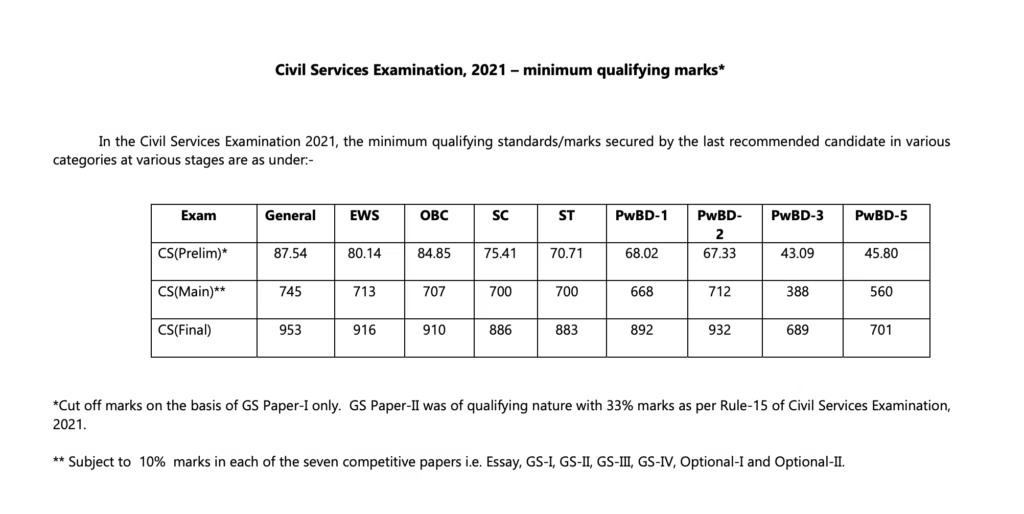
Main Examination (Hand-evaluated): The scenario changes dramatically in the Mains examination, where copies are evaluated manually by examiners, predominantly from upper castes. Here, a noticeable gap emerges. For example, in the 2021 Mains, the General cut-off was 745, while the OBC cut-off dropped to 707. This suggests that when human evaluators are involved, marks for OBC candidates tend to be lower compared to General candidates, despite similar performance in the preliminary stages.[source]
Interview Stage: The disparity widens further after the interview. As seen in the Apala Mishra and Riya Dabi cases, interview marks can dramatically alter ranks, with candidates from marginalized communities often receiving significantly lower scores than their upper-caste counterparts, even if they scored higher in the written exam.
This pattern—comparable performance in computer-evaluated tests, lower marks in human-evaluated written tests, and significantly lower marks in interviews for SC/ST/OBC candidates—points towards a systemic issue rather than a reflection of inherent differences in ability.
Conclusion: The Unseen Barrier
The evidence points towards structural discrimination baked into the latter stages of the UPSC selection process. While the objective Preliminary exam shows parity, the subjective evaluation stages—Mains (written assessment) and the Interview (Personality Test)—introduce variables that disproportionately affect candidates from historically marginalized communities. The subjective nature of the Personality Test, combined with the access interviewers have to candidate background information via the DAF, creates a mechanism where caste prejudice can translate directly into lower final ranks. Until the process incorporates rigorous, transparent scoring metrics for interviews, the claim of systemic caste bias within UPSC recruitment will persist.
What Can You Do?
Combating systemic discrimination requires collective action and persistent advocacy for transparency. Here is how you can contribute:
- Document and Share: If you or someone you know has experienced evident score disparities in the Mains or Interview stage, securely document the scores and share anonymized data with anti-caste organizations or academic researchers investigating this issue.
- Demand Accountability: Write to your elected representatives, demanding specific, measurable reforms for the UPSC interview process, such as implementing joint scoring sheets or video recording interviews to mitigate interviewer bias.
- Support Research: Advocate for third-party, independent audits of UPSC marking data to scientifically verify the claims of caste disparity across all stages of the examination.
- Amplify Verified Information: Share evidence-based articles like this one to counter misinformation and keep the focus on structural reforms rather than individual failings.
Do you disagree with this article? If you have strong evidence to back up your claims, we invite you to join our live debates every Sunday, Tuesday, and Thursday on YouTube. Let’s engage in a respectful, evidence-based discussion to uncover the truth. Watch the latest debate on this topic below and share your perspective!

Skeptical Indian is an independent researcher documenting
caste discrimination through primary sources, Hindu
scriptures, court records, and government data.
CasteFreeIndia.com has published 100+ evidence-based
analyses since 2024.